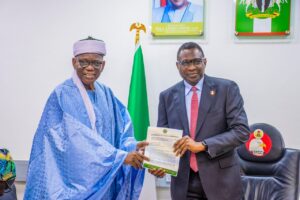

Nigeria has launched a €4.2 million programme supported by the European Union and implemented by the World Health Organization to strengthen the country’s capacity to detect and respond to disease outbreaks.
The initiative, known as the EU Support to Public Health Institutes in Nigeria (EU SPIN), will be carried out over four years in partnership with the Federal Ministry of Health and Social Welfare.
It is aimed at improving the performance of selected public health institutions through better coordination, faster information sharing and enhanced workforce capacity.
Speaking at the launch in Abuja on Monday, the Minister of State for Health and Social Welfare, Iziaq Adekunle Salako, described the programme as a significant step towards strengthening Nigeria’s healthcare system.
ADVERTISEMENT
“This initiative is designed to strengthen our health institutions, and it is truly a welcome development. It will improve the well-being of Nigerians, especially our vulnerable populations,” he said, noting that it aligns with the Federal Government’s broader health reform agenda.
Nigeria continues to face a dual health burden, with recurring infectious disease outbreaks alongside a growing prevalence of non-communicable diseases such as hypertension and diabetes.
According to the World Health Organization, non-communicable diseases now account for 27 per cent of deaths in the country, while malaria alone contributes about 30 per cent of global malaria fatalities.
Recurrent outbreaks of cholera, diphtheria, Lassa fever, meningitis and Mpox also remain a major public health concern.
The EU SPIN programme is expected to address systemic gaps that slow outbreak response by strengthening collaboration among public health institutions and clarifying roles across federal, state and local levels. It will also support real-time data systems to enable quicker and more informed decision-making during health emergencies.
ADVERTISEMENT
A key component of the initiative is workforce development, with plans to train up to 75 per cent of public health staff in leadership, prevention and response strategies, as well as digital skills.
The European Union Ambassador to Nigeria, Gautier Mignon, said the programme reflects a shared commitment to building resilient health systems.
“Through EU SPIN, the European Union is investing in strong, digitally enabled public health institutions in Nigeria. This partnership underscores our commitment to health security and sustainable systems strengthening,” he said.
Also speaking, the WHO Representative in Nigeria, Pavel Ursu, noted that improved coordination and digital tools would enhance the country’s ability to protect lives.
“By improving coordination, skills and digital tools, the project will help protect lives and keep communities healthier,” he said.
ADVERTISEMENT
Officials said the programme would ultimately strengthen links between public health systems and primary healthcare services, ensuring that communities benefit from faster and more effective responses to health threats.
By 2028, the initiative is expected to deliver more efficient inter-agency coordination, clearer institutional responsibilities and more reliable public health data nationwide, with progress tracked through national monitoring systems and periodic reviews involving government and development partners.