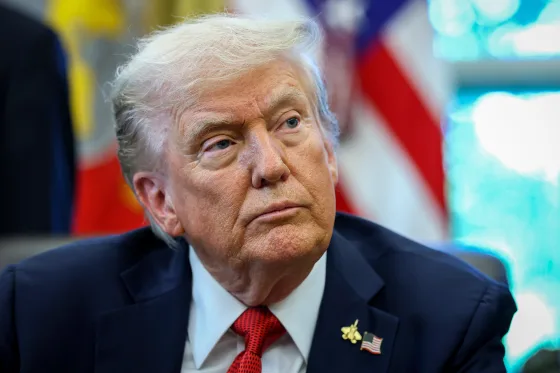
Republican US lawmakers said on Monday that President Donald Trump has no plans to occupy or engage in nation-building in Venezuela, following a classified briefing on the administration’s policy toward the South American country.
“We do not have U.S. armed forces in Venezuela, and we are not occupying that country,” Republican House Speaker Mike Johnson of Louisiana told reporters after the session with Secretary of State Marco Rubio, Secretary of Defense Pete Hegseth, and other senior officials.
Representative Brian Mast, Republican chairman of the House Foreign Affairs Committee, echoed the sentiment, saying: “If anybody wants to use the term nation-building, or anything like that, it doesn’t look like anything anybody has seen under President Trump.”
ADVERTISEMENT
Mast added: “They are not the protracted war administration,” when asked how he would reassure Americans concerned about another “endless war,” similar to the 20-year conflict in Afghanistan.
READ ALSO: Delcy Rodriguez Sworn In By Brother As Interim President Of Venezuela
The remarks come in the wake of Trump’s decision to send U.S. forces into Caracas early Saturday to capture Venezuelan President Nicolas Maduro, who pleaded not guilty on Monday to narcotics charges. The operation unsettled international leaders and drew criticism from some U.S. Democrats, who accused Rubio and other officials of misleading them about the administration’s intentions.
Read Also
Senate Democratic Leader Chuck Schumer said Monday’s briefing raised more questions than it answered. “Their plan for the U.S. running Venezuela is vague, based on wishful thinking and unsatisfying,” he said, adding that he received no guarantees that similar operations would not occur in other countries.
Republicans, however, emphasized that U.S. military involvement is intended to protect the homeland. Mast said: “There’s absolutely a continual plan to use the United States military to protect the homeland of the United States of America.”
The Senate is expected to vote this week on a resolution, co-sponsored by Schumer, that would block further military action in Venezuela without congressional approval. Republicans argue the weekend operation did not require approval because it was brief and primarily a law enforcement action to bring Maduro to court in New York.
ADVERTISEMENT
Congressional critics, including some Republicans, have long raised concerns about presidents bypassing the Constitution’s requirement that only Congress authorize military operations beyond short-term defensive actions. Past efforts to pass war powers resolutions have been blocked by Republicans, including after Trump sent forces to the Caribbean four months ago to target vessels allegedly carrying narcotics.
The Trump administration accuses Maduro of leading a cocaine-trafficking network linked to violent criminal groups such as Mexico’s Sinaloa and Zetas cartels, Colombia’s FARC rebels, and Venezuela’s Tren de Aragua gang. Maduro has denied the allegations, claiming they are a pretext for imperialist designs on Venezuela’s oil wealth.
Trump’s intentions regarding Venezuelan oil are widely known, and U.S. oil company shares surged on Monday amid speculation over potential access to the country’s extensive reserves.