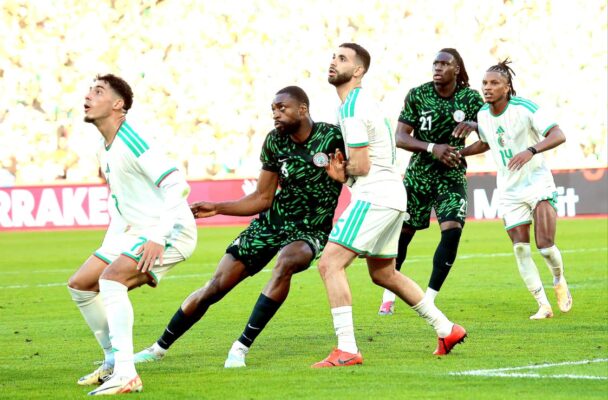
Nigeria’s Super Eagles will return to a familiar and favourable venue on Wednesday when they face Morocco’s Atlas Lions in Rabat, a city where the West Africans have never lost a competitive match against the North Africans.
The only previous senior international meeting between both sides in Morocco’s administrative capital came in August 1983, when Nigeria held the hosts to a 0–0 draw at the Prince Moulay Abdellah Stadium before winning 4–3 on penalties to qualify for the Africa Cup of Nations finals in Côte d’Ivoire, where the Eagles went on to finish as runners-up.
That encounter followed a goalless first leg in Benin City, with then-coach Adegboye Onigbinde making several changes for the return fixture.
Goalkeeper Peter Rufai replaced Wilfred Agbonavbare, while Kingsley Paul, Amos Edoseghe, Anthony Edward, Wole Odegbami and Sunday Daniel also came into the starting line-up.
Morocco, coached by Brazilian José “Mehdi” Faria, featured key players such as Badou Ezzaki, Mustapha El Haddaoui and Abdelaziz Bouderbala, but were unable to break down the Nigerian defence.
READ ALSO: AFCON 2025: CAF Probes Misconduct During Nigeria, Algeria, Cameroon, Morocco Q-Finals Matches
More than four decades later, Nigeria will again walk onto the Rabat turf knowing they have never been beaten by the Atlas Lions in the city.
Read Also
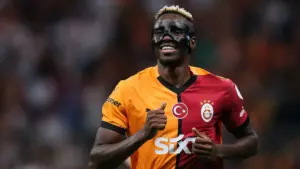
Beyond team history, individual milestones are also in focus. Victor Osimhen goes into the clash chasing one of the most cherished records in Nigerian football.
The Galatasaray striker has scored 35 goals in 51 appearances for the Super Eagles and needs two more to draw level with the late Rashidi Yekini, Nigeria’s all-time leading scorer, who netted 37 goals in 58 matches.
At 27 and in the prime of his career, Osimhen is widely expected to eventually surpass Yekini’s mark. His rise to prominence began in 2015 when he finished as top scorer at the FIFA U-17 World Cup in Chile, helping Nigeria lift the trophy.
Midfielder Alex Iwobi is also approaching a landmark. He is set to earn his 96th international cap, moving closer to the 100-appearance club occupied by former captain Joseph Yobo and ex-goalkeeper Vincent Enyeama, who both reached 101 caps.
Ahmed Musa remains Nigeria’s most capped player with 111 appearances.
Nigeria and Morocco share a long and often intense football rivalry, dating back to their first meeting in 1963.
Over the decades, both teams have exchanged victories across World Cup qualifiers, AFCON matches, Olympic qualifiers and friendlies, with memorable encounters including Nigeria’s 1–0 win in the 1980 AFCON semi-final in Lagos and Morocco’s 4–0 triumph in the 2018 CHAN final in Casablanca.
As the two heavyweights meet again in Rabat, the Super Eagles will be hoping history, form and the pursuit of personal records align in their favour.