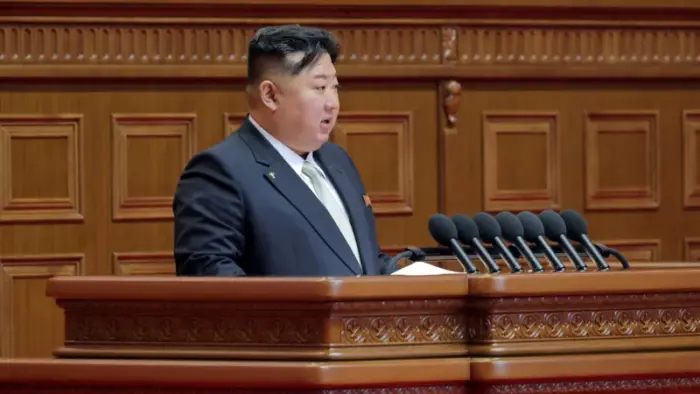
Kim Jong Un has been reaffirmed as general secretary of the Workers’ Party of Korea, cementing his grip on power as the country signals further advances in its weapons programme.
The decision was announced Sunday at the party’s Ninth Congress in Pyongyang, a closely choreographed gathering that observers see as a barometer of North Korea’s political and military direction.
State media described the reappointment as unanimous, underscoring the continued dominance of the Kim family, which has ruled the country since the late 1940s.
According to the state-run Korean Central News Agency (KCNA), the country has “radically improved” its “war deterrence”, “with the nuclear forces as its pivot” under Kim’s leadership. The statement highlights Pyongyang’s emphasis on nuclear weapons despite years of international sanctions aimed at curbing its programme.
ADVERTISEMENT
READ ALSO: Uganda’s ruling party NRM endorses President Museveni as flag bearer for 2026 election
Since assuming power following his father’s death in 2011, Kim has accelerated nuclear and missile development, transforming North Korea into a more formidable strategic concern for Western nations, particularly the United States.
In the days leading up to the congress, the government unveiled what it described as a range of nuclear-capable rocket launchers, fuelling expectations that Kim will outline the next phase of the weapons programme during the ongoing meeting.
Held every five years over the past decade, the party congress is considered the country’s most significant political event.
With about 5,000 members reportedly in attendance, it offers rare insight into the opaque power structure of the regime and its priorities, from economic policy to foreign affairs and defence strategy.
Read Also
This year’s gathering has also brought internal changes. More than half of the 39-member presidium, the party’s executive committee, has been replaced since the last congress in 2021, according to state media, signalling a reshuffle within the upper ranks of leadership.
ADVERTISEMENT
In his opening address, Kim pledged to strengthen the struggling economy and improve living standards, calling them “heavy and urgent historic tasks”.
The remarks come as North Korea continues to grapple with economic pressure from sanctions and limited trade.
Attention has also focused on Kim’s daughter, Ju Ae, amid speculation about succession planning. South Korea’s intelligence agency recently suggested she has been identified as his heir.
Believed to be about 13, she has appeared more frequently at major state functions, including missile inspections and a high-profile military parade in Beijing.
That parade marked a rare moment of visible alignment among North Korea, China and Russia, with their leaders appearing together in a display widely interpreted as a message of solidarity toward Washington and its allies.
On Monday, Xi Jinping congratulated Kim on his reappointment, saying he would work to “write a new chapter in the China-North Korea friendship”, according to Chinese state media.
ADVERTISEMENT
China remains North Korea’s largest trading partner and a crucial source of aid, though Beijing has at times expressed concern over Pyongyang’s expanding nuclear ambitions and its increasingly close ties with Russia.