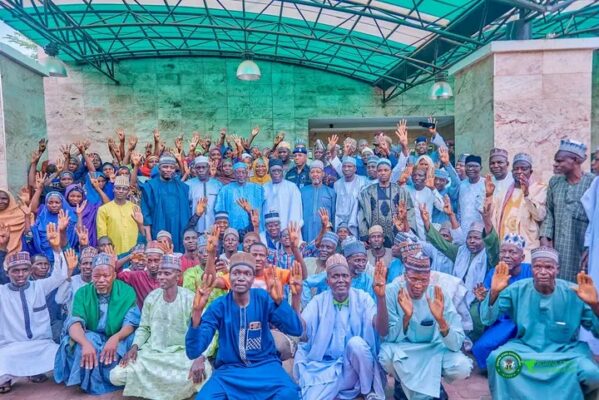
Jigawa State Governor Umar Namadi has received more than 3,000 members of the Peoples Democratic Party (PDP), who defected to the All Progressives Congress (APC) from Sule Tankarkar and Babura Local Government Areas of the state.
Governor Namadi received the defectors on Tuesday at the state council chamber in Dutse, the state capital.
The mass defection is seen as a major political development ahead of future elections, with the defectors describing their move as a step towards supporting continuity, stability, and grassroots development in Jigawa State.
The defectors, led by prominent political figures, Mujittapha Abdullahi and Sani Haruna, said they had spent over 28 years in the PDP before deciding to join the APC.
They said their defection, along with their political supporters and structures across Sule Tankarkar and Babura, signals what they described as the “weakening of the PDP in the area.”
ADVERTISEMENT
Receiving the new members, Governor Umar Namadi said the APC remains the most dominant political party in Jigawa State and assured the defectors of equal treatment, fairness, and full inclusion in the party.
The governor noted that his administration remains focused on delivering people-centred governance, especially in infrastructure, education, healthcare, agriculture, and youth empowerment.
Read Also
He stressed that politics should be about service to the people and not division, assuring that every member of the party would be given a sense of belonging.
Governor Namadi added that with the growing support for the APC across the state, no opposition party can challenge its strength in Jigawa.
The defectors pledged their loyalty to the APC and promised to work for the party’s success from the national level down to the grassroots.
ADVERTISEMENT
They also called for unity, cooperation, and proper accommodation within the party structure.
Chairman of the APC in Jigawa State, Ahmad Garba, described the decision as a wise one, saying the defectors had joined what he called the winning team, committed to the development of the state and the country.
The development may further reshape the political landscape of Jigawa State, especially as parties begin early alignments ahead of future electoral contests.