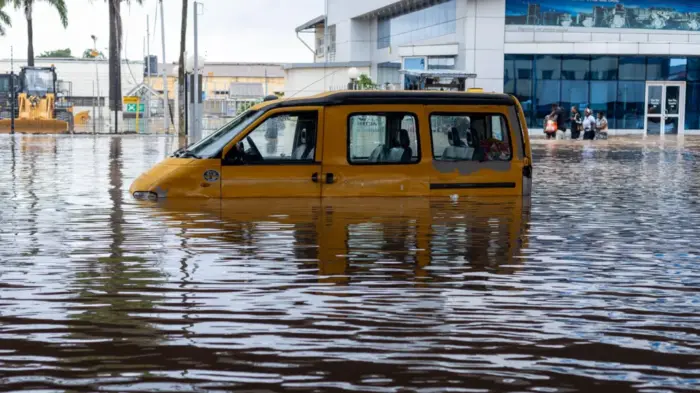
At least 13 people have died after torrential rainfall triggered severe flooding across Ghana’s capital, Accra, with emergency responders warning that the death toll could rise as rescue operations continue.
The Ghana National Fire Service (GNFS) said more than 470 people have been rescued from floodwaters that submerged homes, vehicles and businesses following heavy downpours on Sunday night.
Authorities have deployed emergency response teams, including personnel from the military, police, fire service and the National Disaster Management Organisation, to assist affected communities and protect lives and property.
The government has urged residents to remain indoors if they are in safe locations or move to higher ground where necessary, warning against attempting to cross flooded roads on foot or by vehicle.
“Do not attempt to cross flooded roads, whether on foot or in a vehicle. If your home is being inundated, move immediately to higher ground and call for emergency assistance,” the Presidency said in a statement.
ADVERTISEMENT
President John Dramani Mahama said preliminary data showed that about 140 millimetres of rain fell over Accra, more than double the highest single-day rainfall recorded in 2025, which stood at approximately 56 millimetres.
He said the unusually intense rainfall pointed to the growing impact of climate change.
The Ghana Meteorological Agency has warned that another storm system approaching from the east could bring more rainfall to southern parts of the country, increasing the risk of further flooding.
The flooding also sparked a major fire at a rubber factory in Accra, while electricity supply was temporarily cut to several affected areas after floodwaters damaged power infrastructure.
The Ghana Grid Company Limited (GRIDCo) and the Electricity Company of Ghana (ECG) said the precautionary power outage was necessary to protect electrical equipment and ensure the safety of technical personnel.
ADVERTISEMENT
Markets, businesses and schools in several parts of the capital remained closed as floodwaters gradually receded and residents began assessing the damage.
Many residents recounted losing homes and valuable possessions to the floods, while others remained trapped indoors as water levels rose around their communities.
Accra has experienced recurring floods over the years due to poor drainage systems, blocked waterways and rapid urban development.
Following an aerial assessment of the affected areas, President Mahama directed the demolition of illegal structures built on waterways, describing them as a major contributor to the flooding.
The latest disaster has renewed calls from environmental experts for improved urban planning, stronger drainage infrastructure and greater climate resilience to reduce the impact of increasingly extreme weather events.
ADVERTISEMENT