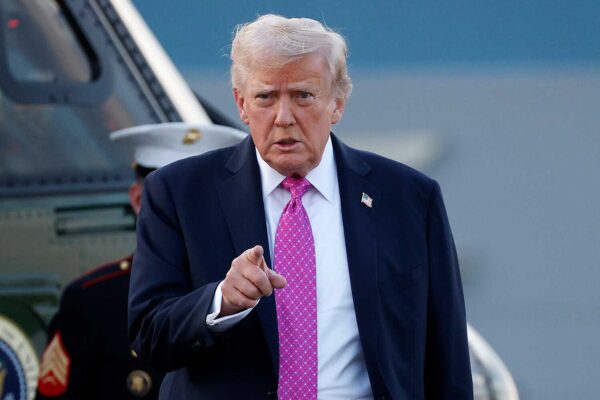
United States President Donald Trump has issued a 48-hour ultimatum to Iranian authorities to reopen the Strait of Hormuz to shipping or face the destruction of its energy infrastructure, as Tehran launched its most destructive attack yet on Israel.
Trump gave the ultimatum a day after saying he was considering “winding down” military operations after three weeks of war, as the key oil passage remained effectively closed and thousands more American Marines headed to the Middle East.
Trump, on Saturday, wrote on Truth Social that the US would “hit and obliterate” Iranian power plants — “starting with the biggest one first” — if Tehran did not fully reopen the strait within 48 hours, or 23:44 GMT on Monday.
The Strait of Hormuz is a narrow, strategically vital waterway connecting the Persian Gulf to the Gulf of Oman and the Arabian Sea, and it is the world’s most important oil chokepoint, with roughly 20% of the world’s total petroleum consumption passing through here daily.
Tehran authorities have launched heavy monitoring of the Strait of Hormuz amid intensifying tensions in the Persian Gulf, driven by the active conflict involving Iran, the United States, and Israel.
In a dual blow to Western interests, Iran has barred ‘hostile’ tankers from the Strait of Hormuz and is reportedly considering a move to shift all trade within the waterway to the Chinese Yuan, effectively bypassing the US dollar.
According to reports, the latest attack on Israel killed over 100 people in the most destructive attack since the war began.
Hours after the said attack, Israeli Prime Minister Benjamin Netanyahu vowed to retaliate “on all fronts” as two Iranian missiles struck southern Israel.
Foreign Minister Abbas Araghchi said Tehran had imposed restrictions only on vessels from countries involved in attacks against Iran, and would assist others that stayed out of the conflict.
In response to Trump’s threat, Iran’s army said it will target energy, desalination infrastructure “belonging to the US and the regime in the region,” according to the Fars news agency.
Read Also
The strikes, which slipped through Israel’s missile defence systems, tore open the facades of residential buildings and carved craters into the ground.
First responders said 84 people were injured in the town of Arad, 10 of them seriously. Hours earlier, 33 were wounded in nearby Dimona, where AFPTV footage showed a large hole gouged into the ground next to piles of rubble and twisted metal.
Dimona hosts a facility widely believed to be the site of the Middle East’s only nuclear arsenal, although Israel has never admitted to possessing nuclear weapons.
The Israeli army told AFP there had been a “direct missile hit on a building” in Dimona, with casualties reported at multiple sites, including a 10-year-old boy in serious condition with shrapnel wounds.
In Arad, emergency workers combed through the rubble of heavily damaged buildings.
Netanyahu vowed to continue striking Iran after what he called a “very difficult evening”, and hours later, the Israeli military said its forces launched a wave of strikes on Tehran.
Iran said the targeting of Dimona was retaliation for Israeli strikes on its Natanz nuclear facility, with the Islamic Revolutionary Guard Corps (IRGC) saying forces also targeted other southern Israeli towns as well as military sites in Kuwait and the UAE.
Following the Natanz attack, UN nuclear watchdog chief Rafael Grossi reiterated his call for “military restraint to avoid any risk of a nuclear accident.”
The Natanz facility hosts underground centrifuges used to enrich uranium for Iran’s disputed nuclear programme and sustained damage in the June 2025 war.