Nigeria has taken a major step toward strengthening its creative economy following the signing of a strategic partnership with the University for the Creative Arts aimed at talent development and industry expansion.
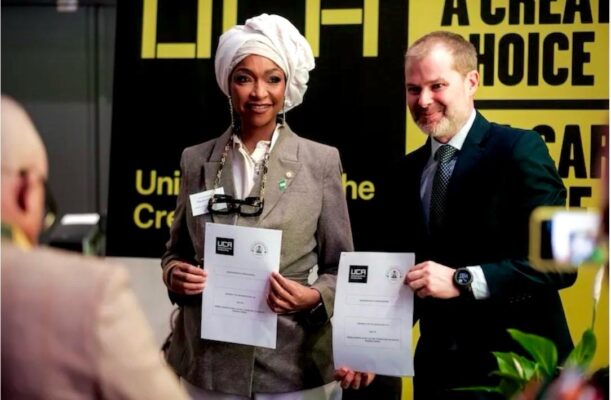
The agreement, formalised through a Memorandum of Understanding (MoU), was signed in Surrey, United Kingdom, by the Minister of Art, Culture, Tourism and Creative Economy, Hannatu Musa Musawa, alongside the Director General of the National Council for Arts and Culture, Obi Asika, and the university’s Joint Vice Chancellor, Mark Ellul.
The partnership is expected to provide a structured framework for collaboration in creative education, curriculum development, institutional capacity building, and industry linkages, as Nigeria seeks to position the sector as a key driver of economic growth and job creation.
READ ALSO: FG Secures Partnership with Coventry University to Deliver UK Degrees in Nigeria
Speaking at the signing ceremony, Musawa described the agreement as the product of sustained engagement between Nigeria and the United Kingdom.
“This partnership has evolved over time and has now entered its implementation phase. Our goal is to establish systems that enable Nigerian creativity to translate into sustainable livelihoods, scalable enterprises, and global industry leadership,” she said.
Nigeria’s creative industry, estimated at nearly $10 billion, has continued to gain global attention across film, music, fashion, gaming, and digital content.
The Federal Government is now focused on strengthening institutional frameworks, modernising curricula, and expanding market access to sustain that growth.
Under the agreement, both parties will collaborate on developing modern creative curricula, faculty exchange programmes, certification systems, and joint training initiatives in key areas such as film, fashion, design, and digital media.
Emphasising the need for strong institutional support, the minister added: “Our responsibility is to transition from cultural influence to a structured industry by creating access, strengthening systems, and ensuring clear pathways from talent to income for Nigerian creatives.”
Asika, in his remarks, highlighted the broader economic impact of the initiative, noting that it would help build a sustainable creative ecosystem through improved institutions, knowledge systems, and access to markets.
As part of the visit, the Nigerian delegation toured the university’s facilities in Farnham and Epsom, including virtual production studios, immersive media laboratories, music production centres, and fashion enterprise platforms.
The tour, officials said, underscored the importance of aligning education with industry standards.
The partnership forms part of a wider national strategy being implemented in collaboration with the National Council for Arts and Culture and the Nigeria Governors Forum to drive growth across states.
Key initiatives include the establishment of innovation and creative hubs, digital platforms such as Discover Naija, diaspora engagement programmes, and year-round cultural activities.
The United Kingdom remains a major partner in Nigeria’s creative economy development, with ongoing collaboration involving institutions such as the British Council and other government agencies.
Both parties stressed the importance of protecting intellectual property and ensuring measurable outcomes from the agreement.
The initiative, aligned with the Renewed Hope Agenda of President Bola Ahmed Tinubu, is expected to strengthen Nigeria’s position as a global creative hub.
Reaffirming the country’s ambition, Musawa said: “Nigeria’s creativity has already made a global impact.
Through strategic partnerships like this, we are building the industries that will harness its full economic value and create opportunities for our people.”