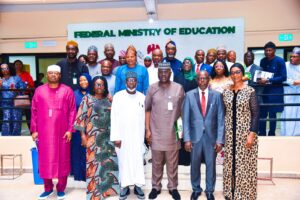

The Federal Government has announced plans to discontinue the policy separating the administration of Junior Secondary Schools (JSS) and Senior Secondary Schools (SSS), saying the arrangement has failed to improve educational outcomes and contributed to the growing number of students dropping out before completing secondary education.
The Minister of Education, Tunji Alausa, disclosed this in a statement issued after inaugurating the Universal Basic Education Commission (UBEC) Ministerial Implementation and Monitoring Committee for Smart Schools, Bilingual Schools and Alternative Schools on Tuesday, June 30, in Abuja.
According to the statement, Alausa said the policy, which created separate management structures for junior and senior secondary schools, would be presented to the National Council on Education (NCE) for review and eventual abolition.
The minister said the current arrangement has created unnecessary administrative challenges, weakened the transition of students from junior to senior secondary school and fuelled the country’s rising number of out-of-school adolescents.
The statement quoted Alausa as saying the government had reached the conclusion that the policy had failed to achieve its intended objectives.
ADVERTISEMENT
“The Federal Government could now objectively conclude that the policy had not delivered the desired results,” the statement quoted the minister as saying.
According to the statement, Alausa stressed that education reforms should focus on improving learning outcomes rather than expanding administrative structures.
He noted that while enrolment into junior secondary schools remains relatively high, progression to senior secondary education has become a major concern, with more than 20 million students reportedly dropping out before completing secondary school.
Describing the trend as unacceptable, the minister directed relevant officials in the Federal Ministry of Education to prepare a position paper for presentation to the National Council on Education to facilitate the proposed policy change.
Meanwhile, the Executive Secretary of the Universal Basic Education Commission (UBEC), Dr. Aisha Garba, highlighted progress made under the Federal Government’s basic education programmes.
ADVERTISEMENT
According to the statement, Garba disclosed that 37 Smart Schools have been established across the country, with 24 already operational and providing academic activities, while the remaining schools are at various stages of completion and preparation for take-off.
She also said that under the UBEC–Islamic Development Bank Bilingual Education Programme, 30 schools have been established across nine states.
The statement quoted Garba as saying that three boarding schools under the programme have been completed and commissioned, while four others are substantially completed and awaiting inauguration.
The Federal Government reaffirmed its commitment to implementing reforms aimed at improving access to quality basic education, strengthening learning outcomes and ensuring that every Nigerian child has the opportunity to complete secondary education.