
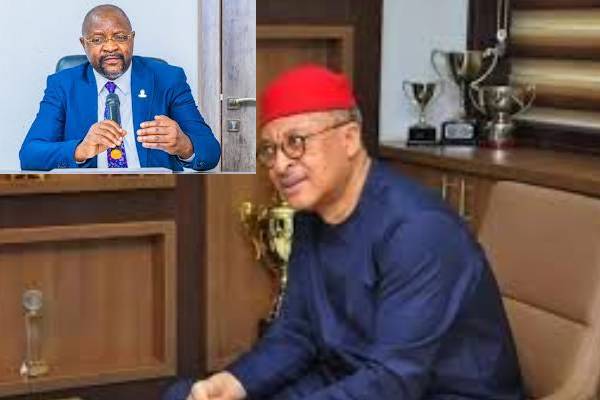
The Special Adviser to President Bola Ahmed Tinubu on Media and Public Communication, Sunday Dare, has strongly criticised economist and public affairs commentator, Pat Utomi, over his recent remarks on the Federal Government’s economic reforms.
Utomi had described the administration’s reform programme as “ridiculous,” “poorly structured,” and likened it to a “Ponzi scheme,” prompting a sharp rebuttal from the presidency.
In a detailed response, Dare dismissed the claims as exaggerated and lacking analytical depth, arguing that Utomi’s interventions in national discourse often rely on alarmist rhetoric rather than evidence-based critique.
He questioned the economist’s record in both the public and private sectors, suggesting a disconnect between his commentary and measurable outcomes from past engagements.
ADVERTISEMENT
Defending the government’s economic direction, Dare maintained that the reforms introduced under the Tinubu administration are structural and aimed at addressing long-standing distortions in the economy.
He cited key policy measures, including the removal of fuel subsidy in May 2023, which he said eliminated a significant fiscal burden and improved revenue allocation to states, as well as the unification of exchange rates to enhance transparency in the foreign exchange market.
According to him, these steps align with longstanding recommendations by global financial institutions such as the World Bank and the International Monetary Fund.
Dare also pointed to improvements in Federation Account allocations, non-oil revenue performance, and efforts to stabilise external reserves as early indicators of progress.
https://x.com/SundayDareSD/status/2044388555342926285
ADVERTISEMENT
He argued that describing the reforms as a “Ponzi scheme” reflects a misunderstanding of macroeconomic principles, noting that the current policies are designed to eliminate inefficiencies, restore market confidence, and rebuild fiscal credibility.
While acknowledging that government policies should remain open to scrutiny, Dare stressed that criticism must be constructive, rigorous, and supported by viable alternatives.
He further highlighted ongoing reforms in taxation, customs modernisation, and digital revenue systems as part of a broader strategy to strengthen Nigeria’s economic framework.
Dare concluded that while dissent is essential in a democracy, it must contribute meaningfully to policy debate, warning that unsubstantiated claims risk distracting from ongoing efforts to stabilise and reform the economy.