
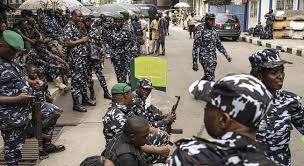
The Senate and House of Representatives have both passed separate versions of the Constitution Alteration Bill on State Police, but key differences must be harmonised before the legislation is sent to the 36 state Houses of Assembly for ratification.
Here are 15 major differences between the two versions:
1. Number of Clauses
The Senate version is more detailed, containing 26 clauses, while the House version has 18 clauses.
2. Scope of Constitutional Amendments
ADVERTISEMENT
The Senate proposes amendments to 11 sections of the Constitution, while the House seeks to amend eight sections, indicating a broader constitutional overhaul by the upper chamber.
3. Sections Targeted for Amendment
The House amends Sections 34, 35, 39, 42, 89, 129, 153 and 197, whereas the Senate amends Sections 84, 89, 121, 124, 129, 157, 158, 160, 197, 201 and 202.
4. Transitional Provisions
The Senate includes seven transitional provisions to guide the establishment of state police forces, while the House version contains no transitional arrangements.
ADVERTISEMENT
5. New Section 214
Both versions replace the current Section 214 of the Constitution, but the Senate introduces 15 new sub-clauses, compared to seven in the House version, making it considerably more comprehensive.
6. Title of Section 215
The Senate renames Section 215 as “Appointment, Command, Direction and Tenure,” while the House titles it “Appointment of Inspector-General of Police and Commissioner of Police of a State.”
7. Head of State Police
ADVERTISEMENT
The Senate proposes that each state police service be headed by a Commander, while the House retains the traditional title of Commissioner of Police.
8. Powers Under Section 215
The Senate inserts 10 new clauses under Section 215, compared with five introduced by the House, giving more detailed provisions on command and administration.
9. Focus of Section 216
Although both chambers replace Section 216 entirely, they assign it different responsibilities.
ADVERTISEMENT
The Senate focuses on National Police Standards, Oversight and Accountability.
The House focuses on the Removal of the Inspector-General of Police and State Commissioners of Police.
10. Oversight Framework
The Senate places stronger emphasis on establishing a national framework for policing standards, oversight and accountability, while the House concentrates more on appointments and removals.
11. Constitutional Schedules
ADVERTISEMENT
The Senate amends the Second, Third and Fourth Schedules to the Constitution, whereas the House proposes amendments to only the Second and Third Schedules.
12. Financial Provisions
Unlike the House version, the Senate amends constitutional provisions relating to public finance, including Sections 84, 121 and 124, to accommodate funding arrangements for state police institutions.
13. Institutional Governance
The Senate also amends Sections 157, 158, 160, 201 and 202, introducing broader governance provisions affecting appointments, tenure and administration.
ADVERTISEMENT
These changes are absent from the House version.
14. Level of Detail
The Senate version provides a more elaborate legal framework covering command structure, implementation, oversight and transition, while the House version adopts a simpler constitutional approach with fewer provisions.
15. Harmonisation Still Required
Despite these differences, both chambers agree on the fundamental principle of creating state police.
ADVERTISEMENT
House Committee on Constitution Review Chairman and Deputy Speaker Benjamin Kalu has said the differences are largely drafting issues and account for less than two per cent of the bill, with harmonisation expected after the House resumes on July 7.
What Both Chambers Agree On
Despite their differences, both versions:
Seek to establish state police through constitutional amendment.
Replace the existing Section 214 of the Constitution.
ADVERTISEMENT
Amend Sections 215 and 216.
Retain the National Police Council as the body responsible for setting minimum policing standards.
Require states to meet national standards before establishing police services.
Provide safeguards against abuse, including sanctions or withdrawal of certification for non-compliant state police organisations.
Require approval by at least 24 state Houses of Assembly before the bill can be presented to President Bola Tinubu for assent.
If harmonised and ratified by the states, the legislation would mark one of Nigeria’s most significant constitutional reforms since the return to democratic rule in 1999.
ADVERTISEMENT