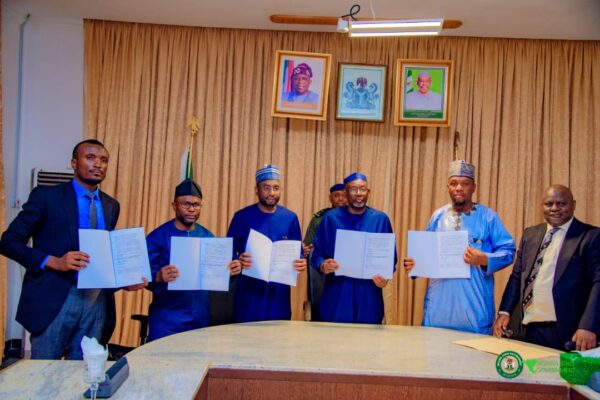
Governor Malam Umar Namadi today presided over the signing of a landmark Memorandum of Understanding (MoU) with a consortium of investors for the large-scale production of alfalfa, under which the Jigawa State Government has committed to providing up to 100,000 hectares of land to support the project, marking one of the largest alfalfa production initiatives in Africa.
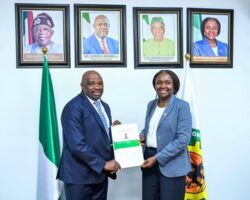
The MoU was signed following a visit by a high-level delegation led by the Director General of the National Information Technology Development Agency (NITDA), Kashifu Inuwa.
The delegation included the Managing Director of NEXIM Bank, Mr. Abubakar Abba Bello; the Managing Director of MOFI, Dr. Armstrong Takang; the Managing Director of Jaiz Bank, Mr. Haruna Musa; and several private-sector partners such as Capemano, Alami Capital, EL-Meena Farms, and Matura Farm, as well as representatives of NSIA and other key institutions.
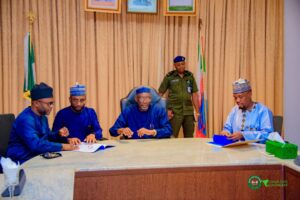
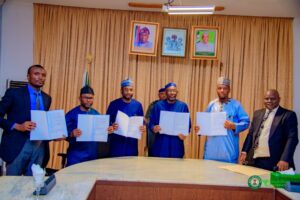
Speaking after the signing, Governor Namadi reiterated Jigawa’s total commitment to agriculture and livestock development, describing agriculture as the backbone of the state’s economy.
“Agriculture is the lifeblood of this state. About 90% of our population depends on it for their livelihood, and it contributes more than 50% of our GDP. Any serious government that genuinely aims to uplift its people should prioritize agriculture.
the governor said.
He highlighted Jigawa’s impressive accomplishments in agriculture, noting its ranking as the second-best state in Nigeria for ease of doing business and its leading role in crop production.
“We are number one in wheat production, and this year alone, we cultivated 315,000 hectares of rice. Our plan to achieve 500,000 hectares by 2030 is fully on track.”
Speaking on livestock development, the governor described alfalfa as a game-changing opportunity for the state.
“Livestock is synonymous with agriculture. That is why we deliberately created the Ministry for Livestock this year. Jigawa is home to the largest livestock market in Africa—the Maigatari market—and this project will further strengthen our leadership.”
The governor expressed strong confidence in the new partnership, saying that the successful alfalfa pilot project by Matura Farm has already demonstrated exceptional global potential.
“When Matura Farm started, many people doubted it was possible. Today, he is producing some of the highest-quality alfalfa in the world.”
he said.
He assured the investors of the state’s readiness to provide the full 100,000 hectares required for the project.
“The project is targeting 100,000 hectares. I want to assure you that we will make all of that available over time.”
Governor Namadi emphasized Jigawa’s peaceful environment and investor-friendly framework as its major advantages:
“We are the most peaceful state in Nigeria today. Jigawa is safe, open for business, and committed to providing all the support you need.”
He further pledged seamless facilitation through the state’s investment promotion agency:
“We have a one-stop-shop investment platform—InvestJigawa—that manages everything from land allocation to regulatory processes. You have found a committed partner.”
“As a government, we will do whatever it takes. This business is profitable—you have the land, the labour, the security, and the political will. Everything you need is here.”
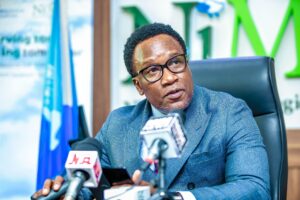
In his remarks, NITDA Director General Kashifu Inuwa stated that the project aligns directly with President Bola Ahmed Tinubu’s priority agenda on food security and expanded agricultural production, confirming that the initiative will take off immediately.
“Priority number two of the President’s agenda focuses on boosting agriculture to achieve food security. The investment-friendly climate in Jigawa is one of the key reasons we are bringing this project here.”
Providing technical insight, the Commissioner for Livestock Development, Professor Salim Mohammed, described alfalfa as a transformative high-protein forage crop capable of boosting livestock productivity, generating mass employment, and expanding export revenues.
“On 1,000 hectares alone, over 150 youths are employed before cultivation begins—and many more will participate through planting, irrigation, harvesting, processing, and marketing.”
He noted that herding communities, especially Fulani pastoralists, will directly benefit from improved feed availability.
“Fresh alfalfa significantly improves milk production, meat quality, and breeding outcomes.”
He confirmed that the project represents a multi-billion-naira investment.