With the countdown to the biggest sporting event in history officially underway, football fans across the globe are turning their eyes toward North America, the host continent for the 2026 FIFA World Cup, featuring an expanded format of 48 nations, promises to be a tournament of unprecedented scale.
To help you navigate the journey from the opening whistle in Mexico City to the grand finale in New Jersey, TVC News have compiled the full list of host cities, their sporting history and some of the iconic stadiums that will define this summer’s global showpiece.
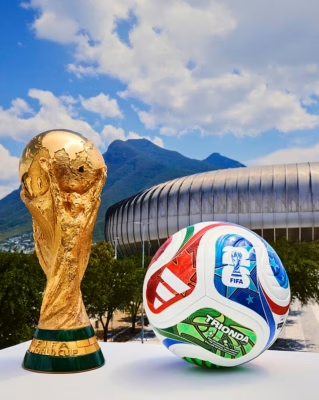
In October 2025, FIFA unveiled the official AI-powered “Trionda” ball by Adidas for the 2026 World Cup.
The Adidas Trionda, meaning ‘three waves’, was out officially for £119/$160, designed to help match officials as much as players, with interior technology informing offside and handball decisions.
It’s painted white, red, blue, and green, which celebrate the colours of the host nations, the United States, Canada, and Mexico, and is reminiscent of the 2014 Brazuca.
The design features a blue star for the USA, a red maple leaf for Canada and a green eagle for Mexico.
‘It’s the most visually playful FIFA World Cup ball we’ve ever created,’ said Sam Handy, general manager at Adidas Football. ‘A piece of craftsmanship built for the biggest stage, that makes you want to hold it, admire it, and above all, play with it.’
Canada
Toronto: As Canada’s largest city, Toronto is a globally renowned destination for its culinary scene, nightlife, extensive green spaces, music, film and cultural festivals, and major sporting events. Over 150 neighbourhoods, from Little Italy and Chinatown to Queen West and Yorkville, contribute to the city’s vibrancy and diversity, each with their own unique character.
BMO Field (Toronto Stadium during FIFA World Cup 2026) is Canada’s first soccer-specific stadium and plays home to Canada’s National soccer team, the Toronto Argonauts (CFL), as well as Toronto FC (MLS). The City hosted the 1976 Olympic Football Tournament, the 1974 Concacaf Youth Championship, the 1987 FIFA U-16 World Tournament, the 1998 Concacaf Women’s Championship, the FIFA U-20 World Cup Canada 2007™ and the FIFA U-20 Women’s World Cup Canada 2014™.
Vancouver: Vancouver staged nine incredible matches during the FIFA Women’s World Cup Canada 2015™, including the final of the global showpiece where USA defeated Japan to win their third world title and first since 1999.
The city is home to MLS team Vancouver Whitecaps FC. The club was founded in 2009 and three years later they became the first Canadian side to qualify for the MLS Cup Playoffs. The Whitecaps have won two Canadian Championships, triumphing in 2015 and 2022.
Canada national team ace Alphonso Davies is the Whitecaps’ most celebrated player. Davies’ eye-catching performances earned him a move to European heavyweights Bayern Munich, where he has established himself as a key player.
Mexico
Guadalajara: Currently there are two top division football teams including Club Deportivo popularly known as Chivas de Guadalajara with a home-grown players policy and Los Zorros de Atlas.
Chivas is one of the 10 founding members of the Mexican first Division and used to also own Chivas USA which played from 2005 to 2014 in Major League Soccer in Los Angeles.
As in most Mexican cities, football is played every day in the streets and parks. But the city of Guadalajara is helping push that even further, having established numerous projects to promote sports in schools in order to teach children healthy lifestyles, develop social values and generate teamwork habits.
Mexico City: Mexico City is the only city in North America that has three professional football teams including Club America, Club UNAM and Cruz Azul. On average, Mexico City hosts 75 professional football matches per year.
The city has hosted two FIFA World Cup Finals. The 1970 competition was the first staged in North America, and the second in 1986. Mexico City has also hosted the first ever Central American and Caribbean Games with two more following, two Pan American Games, and the XIX Olympic Games in 1968. Mexico City has hosted a series of other world-class events such as the Formula One Mexico Grand Prix, as well as regular season games of the NFL and NBA.
Monterrey: The 1970 FIFA World Cup in Mexico, combined with an improvement in C.F. Monterrey’s performance over the following years, turned football into a social phenomenon by 1973. In 1974, Tigres UANL won a spot in the first division, providing the city with a strong rivalry, with both local stadiums sold-out season after season.
The metropolitan area of Monterrey was integrated with the historic city of Guadalupe, which was first settled in 1716. Between 1880 and 1910, the city of Monterrey went from being a regional commercial hub to the industrial capital of Mexico. Monterrey has become a busy working hub with growing social diversity. Sports are an important social activity, bringing people together no matter their income level, social class, gender or background.
USA
Atlanta: Atlanta is a blossoming football city that frequently hosts USA national team games and has many youth football development programs. As a host of the FIFA World Cup 2026™, Atlanta will use the opportunity to further promote the game, as well as use football educational programs to teach about environmental issues.
Boston: Boston’s football tradition dates to the Oneida Football Club in the late 19th century, cited as one of the first football clubs established anywhere outside of England. The club had an impressive record, going undefeated for most of its seasons between 1862 and 1867.
Boston has played host to three FIFA championships: the 1994 FIFA World Cup USA™, and the FIFA Women’s World Cup™ in 1999 and 2003. It has teams in all the major professional sports: the New England Revolution (MLS), the New England Patriots (NFL), the Boston Celtics (NBA), the Boston Bruins (NHL), and perhaps the city’s greatest passion, the Boston Red Sox (MLB).
Dallas: North Texas became home to the Dallas Burn in 1995, and played in its first game in front of 27,779 fans. In 2004, the team was renamed to FC Dallas. Today, the North Texas football community is one of the largest in the United States, with nearly 176,000 registered players.
The Dallas Cup, the largest international youth football event in the country, annually brings the world’s finest young players and more than 150,000 spectators to Dallas. Of special significance in the Dallas and North Texas’ history is the 1994 FIFA World Cup USA™, when six games were hosted, and FIFA placed its tournament headquarters and the IBC in Dallas.
Houston: The tournament will provide a once-in-a lifetime experience for Houstonians, with the city leveraging the spirit of the event to leave a lasting legacy to football in the United States. Houston already supports many youth recreational programs and competitive clubs under South Texas Youth Soccer Association (STYSA), with over 100,000 members.
Houston Dynamo became the fourth professional team in Houston. The Dynamo won back-to-back MLS Cups in 2006 and 2007 and are one of the top franchises in MLS. The others are the Houston Astros (MLB), Houston Texans (NFL), and Houston Rockets (NBA).
Kansas City: This is a passionate football city that has a rich history of successful professional football teams, from the Kansas City Spurs of the North American Soccer League to the Comets and Attack of indoor football to the current-day MLS Sporting Kansas City and NWSL KC Current.
While also boasting professional teams in three major sports: Sporting Kansas City (MLS), KC Current (NWSL), Kansas City Chiefs (NFL) and the Kansas City Royals (MLB), the city has hosted multiple FIFA World Cup™ qualifying matches, Concacaf Gold Cups (2011, 2015), men’s and women’s Concacaf Olympic qualifiers, the 2013 MLS All-Star game, and the 2013 MLS Cup Final.
Los Angeles: Los Angeles was a founding city of Major League Soccer (MLS) and was a proud home of the North American Soccer League a generation ago. Many historic football matches have been staged in the Los Angeles Stadium including the 1994 FIFA World Cup USA™ Final, the FIFA Women’s World Cup 1999™ Final, and many key Concacaf Gold Cup matches.
These events have helped further grow the game and today there are 130,000 registered players, 10,300 teams, and 240 leagues and clubs across Southern California. Los Angeles is the only city in the US with seven teams in the five major American sports leagues and two teams in the MLS – Los Angeles Galaxy and Los Angeles FC.
Miami: The adult football infrastructure in Miami includes every level of participation: amateur, semi-professional, and a truly rich history of professional football organizations that have participated in nearly every major professional league since the beginning of organised pro football in the States.
Professional football in Miami started with the North American Soccer League’s Miami Gatos in the late 1960s and early 1970s, then with the Miami Toros in the mid-1970s, continuing with the Fort Lauderdale Strikers in the late 1970s and early 1980s. In 1998, Major League Soccer (MLS) created the Miami Fusion but the team dissolved in 2002. These days, Inter Miami – who are owned by David Beckham – represent the city in MLS.
New York New Jersey: New York New Jersey has three professional football teams, NYCFC, New York Red Bulls and NJ/NY Gotham FC, and a huge youth football base that will only increase in both size and quality of play as interest in those teams grows.
Football in the region has always drawn large crowds. Highlights include Pele and the Cosmos in the 1970s, the 1994 FIFA World Cup USA™ (seven matches including a quarter-final and semi-final), the FIFA Women’s World Cup 1999™ (Opening Ceremonies and USA’s opening round match), the Concacaf Gold Cup Final in 2009, and the Copa America Centenario Final in 2016 which drew a record crowd of 82,026.
Philadelphia: The 1970s saw the Atoms and Fury of the North American Soccer League (NASL), and the 1980 to 90s saw the rise of indoor football with the Philadelphia Fever of the MISL, and Philadelphia KiXX of the NPSL. In 2008, MLS awarded Philadelphia the 17th expansion team with the Philadelphia Union.
In 2003, Philadelphia Stadium opened with the highly anticipated, sold-out match featuring Manchester United and Barcelona, with 68,000 fans, and in the same year played host to the FIFA Women’s World Cup USA 2003™ drawing 56,000 fans, among the largest crowds of the tournament.
Seattle: With some of the most ardent and passionate fans in Major League Soccer (MLS), Seattle Sounders are a thriving club, while there are many youth players developing the game from a grassroots level. In addition, the RAVE Foundation is building urban, accessible football fields and futsal courts for free play, that is dedicated to open use by the community.
Each and every step of the way Seattle has attracted large, passionate crowds for professional matches. In the early years of the NASL, the Seattle Sounders were consistently among the football league’s attendance leaders with more than 20,000 attendees per game. In 1976, an exhibition game with the New York Cosmos and Pele produced a sellout crowd of 58,000; a North American record at the time.
San Francisco Bay Area: Since 1967, the Bay Area has been home to professional football teams from San Jose, San Francisco and Oakland areas. The region has also hosted international matches during the 1984 Olympics, 1994 FIFA World Cup USA™ and FIFA Women’s World Cup USA 1999™.
In the recent past, San Franscico Bay Area Stadium hosted the Concacaf Gold Cup, the Copa America Centenario and the International Champions Cup. Along with those official competitions, the region has hosted hundreds of international exhibitions including Real Madrid, Barcelona, Chelsea, Arsenal, Manchester United, Chivas, Club America and Bayern Munich.