The high-stakes African playoff between Nigeria and the Democratic Republic of Congo (DR Congo) for the 2026 FIFA World Cup has escalated from a tense penalty shootout into one of African football’s most controversial stories of 2025.
What started as a dramatic on-field contest has now evolved into a legal and regulatory dispute involving player eligibility, national citizenship laws, and FIFA’s interpretation of its rules. The outcome could ultimately reshape Africa’s representation at football’s biggest stage.
A match of fine margins
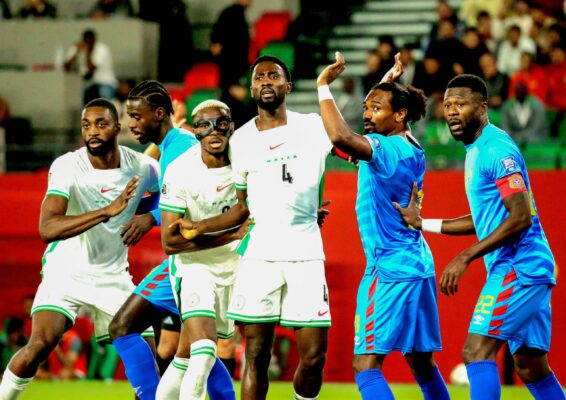
On November 16, 2025, Nigeria and DR Congo faced off in Rabat, Morocco, for a decisive one-off CAF playoff. Nigeria drew first blood with an early goal from Frank Onyeka, but DR Congo equalised before halftime through Meschack Elia. The match remained deadlocked after extra time, forcing a penalty shootout. DR Congo’s composure from the spot, capped by Chancel Mbemba’s decisive penalty, secured a 4–3 victory and kept their World Cup dream alive, ending Nigeria’s campaign on the pitch.
The game itself was a study in momentum swings. Nigeria pressed aggressively early, but DR Congo gradually tightened their structure and capitalised on counterattacks. Both sides struggled to create clear-cut chances in the second half and extra time, and fatigue played a decisive role as nerves dominated the penalty decider.
The stakes
For DR Congo, the victory represents a rare chance to return to the World Cup for the first time since 1974, validating years of rebuilding around Europe-based talent. For Nigeria, the loss was a bitter repeat, marking the second consecutive failure to qualify and intensifying scrutiny on coaching strategies and federation management.
From superstition to formal complaints
Immediately after the match, Nigeria’s head coach hinted at unusual behaviour from the DR Congo bench during penalties, sparking discussion about distraction or superstition. Analysts largely dismissed these claims.
The more serious turn came in December 2025, when the Nigeria Football Federation filed a formal petition with FIFA, alleging that DR Congo fielded ineligible players based on the country’s domestic citizenship laws.
READ ALSO: DR Congo Official Used Voodoo During Penalty Shoot-out, Chelle Alleges
The citizenship question
DR Congo’s constitution generally forbids dual citizenship, meaning that a citizen should not hold another nationality unless specific legal steps are followed. Nigeria’s complaint asserts that several DR Congo players, many born or raised abroad, may not have fully complied with these nationality requirements before representing the national team. While these players reportedly held Congolese passports, Nigeria contends that a passport alone does not satisfy the legal obligations under domestic law.
FIFA’s eligibility framework
FIFA evaluates player eligibility based on sporting nationality, not domestic constitutional law. A player must hold the country’s nationality and, if switching allegiance, complete FIFA’s one-time switch process. Typically, possession of a valid passport is sufficient. FIFA pre-cleared all DR Congo players prior to the qualifiers, forming the backbone of the Congolese federation’s defence.
What the rules suggest
DR Congo currently holds a strong position. All players were cleared by FIFA before the playoff, held valid nationality documents, and were approved through FIFA’s established processes. Historically, FIFA is reluctant to overturn match results if players competed in good faith and had prior clearance.
Unless Nigeria can prove fraudulent documentation or deliberate misrepresentation, the most likely outcome is that DR Congo’s victory will stand. FIFA’s investigation, however, is ongoing, and Nigeria’s hopes now hinge on procedural rather than sporting factors.
The broader implications
This dispute highlights a growing tension in international football between national laws and FIFA’s global eligibility rules, especially in Africa, where many teams rely heavily on diaspora players. The case raises questions about whether clearer alignment is needed to prevent future controversies.
Whatever FIFA decides, the Nigeria vs DR Congo qualifier will be remembered not only for its dramatic penalty shootout but also for the legal and regulatory debates it has ignited across African football.