
As AI continues to creep into different workplace settings and disrupt industries, the global creative community has been locked in a state of quiet, but growing anxiety. Designers are grappling with a single question: What does the rise of AI mean for the future of human creativity?
To address this, and surprisingly, Cardtonic, a Nigerian-founded fintech platform best known for its gift card trading, virtual dollar card, bill payment, eSIM, and gadget store services, published Design is Changing, a 30-slide research report mapping eight specific design trends on visual communication in the AI era. This report has easily become one of the most rigorous pieces of research to emerge from the Nigerian design industry this year.
Even more impressive, the report is made available, free and ungated, for access. The research effort was also not outsourced to any vendor; it was created fully in-house by the Cardtonic creative team.
Why a Fintech Company Decided to Provide Clarity in the Creative Industry
Design is Changing was never intended as a marketing strategy for Cardtonic. It was a project born out of the natural curiosity of the company’s creative team. They noticed a prevalent problem affecting the design community and decided to address it. According to Muhammad Oni, Product designer at Cardtonic, “We didn’t build this report to sell something. We built it because the designers deserve better than panic. They deserve clarity”.
ADVERTISEMENT
This move is actually a mirror of Cardtonic’s broader philosophical approach to business. The company has always focused on removing barriers for users attempting to participate in the global economy. By applying that same investigative lens to the creative sector, the team is attempting to provide a roadmap for designers who feel like they are hitting a wall.
“Every product Cardtonic has ever built answered one question: does this solve a real problem for someone trying to participate in the global economy but hitting a wall? This report asks the same question, just for creatives”, noted Ima Asuquo, Creative Lead at Cardtonic.
Insights from the Report
The findings from the Design is Changing report are actually interesting because it counteracts the popular opinion that the future of AI will be ruled by the perfect outputs of AI. Instead, it suggests we are entering an era where “deliberate imperfection” is the new premium.
The Rise of Organic Imperfection
ADVERTISEMENT
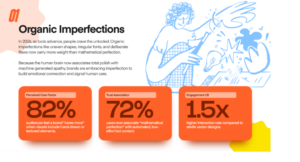
The report highlights a change in user perception towards perfect designs, with “72% of users now associating mathematical perfection with automated, low-effort content”. This should reshape the design strategy for brands in
this era, as the lesson is that “perfect” is no longer the goal, “authentic” is. Because for users, imperfect designs have been shown to “generate 1.5x higher interaction rates than sterile vector designs”.
The Shift to Hyperbold Typography
The report also highlights an increasing retreat towards simplicity, with complexity becoming cheaper to produce. This is evidenced by the massive shift in layout architecture, with “80% of the canvas now occupied by typography in hyperbold layouts”. This is a significant increase from the 25% use of this typography in traditional designs. Also, from a cognitive science perspective, this wins because “bold typography is processed 40% faster in the human brain compared to complex, cluttered imagery”.
The Return of Emotion and Personality
The report further notes the return of emotion and personality as the new edge in brand design. 70% of users now explicitly state they “prefer human, approachable brands, and they are significantly more forgiving of flaws in human-led designs than in AI-generated ones”. Also, 82% of users feel a brand cares more when visuals include “hand-drawn or textured elements”. With this, it is clear that the new user attraction is imperfection and human effort.
The Merger of Code, Creativity, and Strategy
ADVERTISEMENT
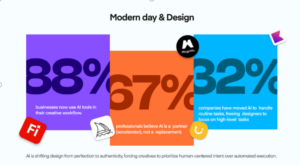
Perhaps, the most pragmatic insight from the report is how the design workplace has begun collaborating with AI. First, 88% of businesses now use AI in their creative workflow. Second, 67% of professionals believe AI is a partner (accelerator) and not a replacement. This is very crucial for sustainability and the prevention of job disruptions in the sector. Also, 32% of companies have successfully reoriented their creative workflows so that AI handles the routine, repetitive tasks, freeing designers to focus on high-level strategy, emotion, and storytelling.
Closing Thoughts
Cardtonic putting together the Design is Changing report is an impressive and commendable achievement. By sifting through the clutter to provide clear and actionable insights to the role of the emergence of AI in today’s design
ecosystem, they have provided the much needed clarity the African and global community seek.
As the industry continues to evolve in the AI era, the distinction between those who embrace its potential and those who are displaced by it will only grow. For the designers, agencies, and brands reading this report, the takeaway is clear: the future belongs to those using AI to sharpen their craft, rather than diminish it.
As Precious West, Lead Designer at Cardtonic, succinctly puts it: “The designers who win in 2026 aren’t those who have made enemies of AI. They’re the ones who know exactly its use, and what to never let it decide”.
ADVERTISEMENT