
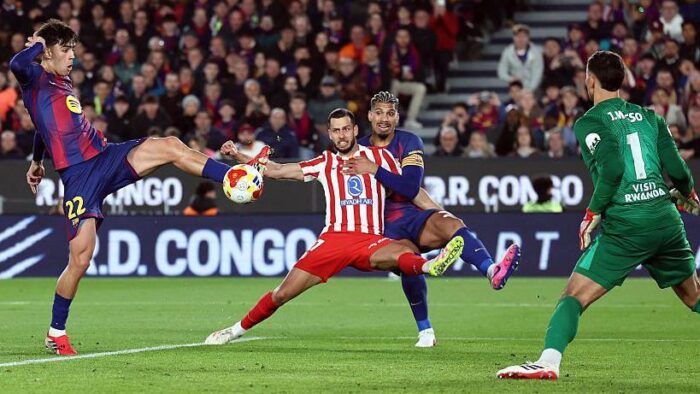
Barcelona’s Champions League defeat to Atlético Madrid has ignited a fierce refereeing controversy, with the Spanish giants accusing officials of a decisive error—while a long-running scandal over alleged payments to referees continues to cast a shadow over the club.
The flashpoint came during the quarter-final clash, when Atlético defender Marc Pubill appeared to handle the ball inside his own penalty area.
Barcelona players protested immediately.
But referee István Kovács waved play on, ruling that the ball had not yet come into play from the goal kick.
ADVERTISEMENT
There was no penalty, No booking, And crucially, no intervention from VAR.
Barcelona argue the ball was already in play, making the handball a clear infringement that could have altered the course of the match, which ended in a damaging 2-0 defeat.
Within hours, the club lodged a formal complaint with UEFA, describing the decision as a “major error” and calling for a full review, including access to VAR communications.
However, under UEFA regulations, even if an officiating mistake is acknowledged, the result will not be overturned.
While Atlético Madrid take control of the tie on the pitch, the controversy has quickly widened beyond a single incident.
ADVERTISEMENT
It has revived scrutiny of Barcelona’s own relationship with referees—particularly the ongoing Negreira case in Spain.
The case centres on payments made by the club between 2001 and 2018 to companies linked to José María Enríquez Negreira, a former vice-president of Spain’s referees’ committee.
Prosecutors allege the payments—estimated at around €8 million—may have been intended to influence refereeing decisions.
Barcelona have consistently denied any wrongdoing, maintaining that the funds were for legitimate technical analysis and scouting reports.
No final legal ruling has yet been delivered.
ADVERTISEMENT
The overlap of both issues has intensified debate across European football.
A club under investigation over alleged referee influence is now protesting refereeing decisions at the highest level of the game—raising questions for critics, while fuelling a sense of grievance among supporters.
For now, the focus shifts to the return leg, where Barcelona must overturn a two-goal deficit to keep their Champions League hopes alive.
But regardless of what happens on the pitch, the controversy surrounding officiating—and the wider questions about trust, transparency and integrity—are unlikely to fade anytime soon.