The Economic Community of West African States (ECOWAS) has declared a state of emergency across the region.
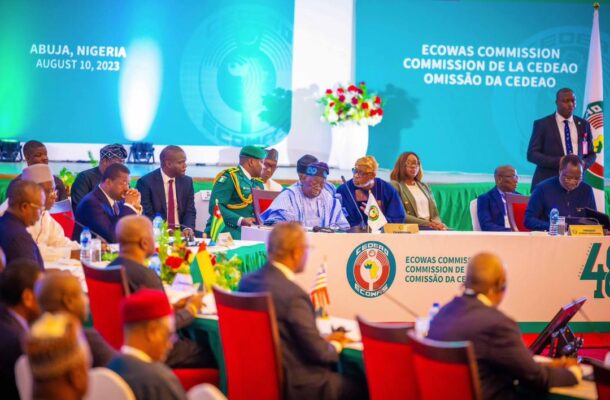
The announcement was made by ECOWAS Commission President Omar Touray on Tuesday during the 55th session of the Mediation and Security Council, held at the ministerial level in Abuja.
The meeting was convened in response to a recent wave of coups and failed mutinies in the sub-region.
Touray emphasised that the events underscore the “imperative of serious introspection on the future of our democracy and the urgent need to invest in the security of our community.”
Addressing ministers, diplomats and senior officials, Touray delivered a stark appraisal of the political and security situation in West Africa, pointing to a series of recent incidents as signs of a rapidly worsening environment.
He noted that ECOWAS member states currently face an average rating of “high risk,” based on country-by-country assessments submitted to the ministers.
“Events of the last few weeks have shown the imperative of serious introspection on the future of our democracy and the urgent need to invest in the security of our community.
“As you would have seen in the memoranda before you, the country-by-country analyses of our member states show different risk levels across our community, from high to medium, with an average of high risk, thereby demanding immediate and concerted action.
“The risk factors are the persistence of military interventions (Guinea-Bissau and the Republic of Benin just days ago); non-compliance with transition norms in Guinea, where we face a military leader turning civilian; growing erosion of electoral inclusivity across multiple states; expanding influence of terrorists, armed groups and criminal networks; and increasing geopolitical pressures affecting member states’ diplomacy and cohesion,” he explained.
Among the most troubling trends, Touray underscored that “elections have become a major trigger of instability in our community.”
He also cited recent attempted coups and ongoing engagement with the Alliance of Sahel States, stressing the need for a unified regional strategy to confront terrorism and cross-border crime.
READ ALSO: ECOWAS Opens 55th Security Council Meeting In Abuja
Calling the moment unprecedented, he warned, “Faced with this situation, Excellencies, it is safe to declare that our community is in a state of emergency.”
Touray urged more frequent meetings of the Mediation and Security Council over the next year, insisting that ECOWAS must “pool our resources to confront the threats of terrorism and banditry, which operate without respect for territorial boundaries.”
He outlined priority areas requiring continuous oversight, including the situation in Guinea-Bissau, the management of political transitions, rising political exclusion, and the need to protect regional unity amid increasing external pressures.
Read Also
Drawing attention to worsening humanitarian conditions, Touray referenced recent UNHCR data. He said that “as of October 2025, approximately 7.6 million individuals are forcibly displaced across the region,” including more than 6.5 million internally displaced persons.
According to the figures, the largest displaced populations are in Nigeria, Burkina Faso, Niger and Mali, while Niger, Mali, Nigeria, Côte d’Ivoire and Togo host the highest numbers of asylum seekers.
Touray stressed, “We must therefore take decisions and actions that will reverse this trend.”
Despite the severity of the challenges, he reaffirmed the bloc’s commitment to its people.
“Let me assure our community citizens that we will not rest on our oars. We will continue to work harder to promote a peaceful, stable and stronger region for the overall benefit of Community citizens,” he said.
He called on member states to uphold constitutional norms and unity: “Let us all remain committed to preserving regional unity, advancing peace and upholding the Community’s Constitutional Convergence Principles.”
Touray also welcomed new ministers attending the session for the first time.
“May I extend a warm welcome to the new Ministers of Defence of Nigeria, Rtd. General Christopher Musa, and Foreign Affairs of Cabo Verde, José Luis Livramento, who are joining today for the first time,” he said.
In his remarks, Sierra Leone’s Minister of Foreign Affairs and Chair of the Council of Ministers, Timothy Kabba, urged decisive measures to safeguard democratic governance amid rising instability.
Kabba pointed to the recent turmoil in Guinea-Bissau and Benin, stating: “The recent coup in Guinea-Bissau and the attempted coup in the Benin Republic are sobering reminders of the fragility of our democratic gains.”
He explained that he led a high-level delegation to Guinea-Bissau on December 1, 2025, to meet with military and political leaders.
“His Excellency’s engagement helped ease tensions and opened the door for continued dialogue under ECOWAS’s guidance.
“These actions reflect our collective position. ECOWAS cannot and will not accept this development. They undermine everything our community stands for and threaten the peace and security of our citizens,” he said.
Kabba stressed the need for clear, meaningful outcomes from the session.