
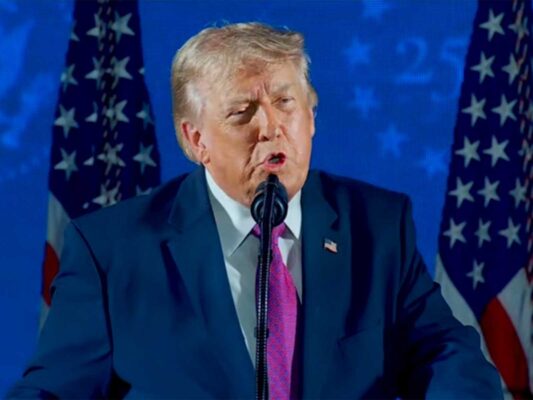
US President Donald Trump ended the NATO summit in Ankara on a conciliatory note on Wednesday after beginning the day with sharp criticism of alliance members over their response to the United States’ military campaign against Iran.
According to AFP, Trump’s shift in tone became evident after a closed-door meeting with leaders of the alliance, where he praised the outcome of the talks and projected unity among member states.
“It was a great meeting, there was a lot of love in that room, a lot of unity,” Trump told reporters after the meeting of the 32 NATO heads of state in the Turkish capital.
A source who attended the session said Trump assured fellow leaders that Washington remained committed to the alliance, declaring, “We want to remain with you.”
The summit concluded with NATO leaders reaffirming their “ironclad commitment” to Article 5, the alliance’s collective defence clause, stressing that “An attack on one is an attack on all” in a show of solidarity amid lingering concerns over the United States’ long-term commitment.
ADVERTISEMENT
Earlier in the day, however, Trump had criticised NATO allies for failing to support the US campaign against Iran. He also threatened trade measures against Spain and reiterated his interest in Greenland, an autonomous territory of fellow NATO member Denmark.
“I’m very upset with NATO … because of what they did with Greenland, and … because of the fact that they didn’t want to help us with the number one state sponsor of terror, that’s Iran,” he said.
Read Also
Read Also: NATO Showcases New Arms Deals to Reassure Trump
Officials familiar with the closed-door discussions said Trump’s rhetoric softened considerably during the meeting, contrasting with his earlier public remarks.
One participant noted that Trump’s comments on Iran were less confrontational than previous statements, while issues involving Spain and Greenland did not resurface during the leaders’ discussions.
ADVERTISEMENT
Estonian Prime Minister Kristen Michal described Trump’s intervention as constructive, saying he encouraged European allies to increase defence spending and take greater responsibility for regional security.
Lithuanian Foreign Minister Kestutis Budrys also downplayed concerns that Trump’s earlier comments reflected divisions within the alliance, arguing that they should not be interpreted as evidence of a weakening transatlantic partnership.
“I wouldn’t see in it an indicator that we are somehow weakening NATO, and that the transatlantic bond is not there,” he said.
“I think we should dramatise things less.”