President Bola Tinubu has defended his administration’s decision to remove the Federal Capital Territory Administration (FCTA) from the Treasury Single Account (TSA), saying the policy has accelerated infrastructure delivery and transformed Abuja through improved financial flexibility.
The President also rejected claims that the executive was interfering in the judiciary by providing infrastructure for the legal sector, insisting that such support was a constitutional responsibility of government.
Tinubu made the remarks on Monday while commissioning the new Office Annex of the Body of Benchers and 10 units of four-bedroom staff quarters at the Nigerian Law School in Bwari, Abuja. He was represented by the Secretary to the Government of the Federation, Senator George Akume.
According to the President, the decision to exempt the FCTA from the TSA enabled the administration to eliminate bureaucratic bottlenecks and improve access to funding for critical projects.
“When we pulled the FCT Administration out of the Treasury Single Account (TSA), there were skeptics. There were those who questioned the wisdom of that financial liberation. But we did it because we knew that local administration must have the liquidity, the speed and the corporate flexibility to interface with financial institutions and deliver critical projects without bureaucratic strangulation. Today, the results are glaring,” Tinubu said.
ADVERTISEMENT
He commended the Minister of the Federal Capital Territory, Nyesom Wike, for translating the policy into visible development projects, saying the minister had not only expanded infrastructure but also strengthened institutions critical to justice and governance.
Tinubu also praised Wike for resolving the Nigerian Law School’s long-standing land title issue by facilitating the issuance of its Certificate of Occupancy after years without formal documentation.
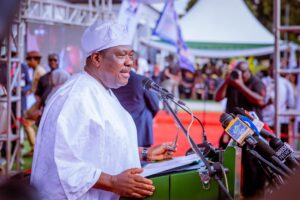
The President said Wike had fulfilled the mandate to transform Abuja into a modern, functional and globally competitive capital city through extensive infrastructure renewal over the past three years.
Speaking at the commissioning of the Body of Benchers’ Office Annex, Tinubu described the new facility as a demonstration of his administration’s commitment to the rule of law, democratic governance and strong institutions.
ADVERTISEMENT
He dismissed suggestions that providing infrastructure for the judiciary amounted to executive interference, maintaining that government had a constitutional obligation to provide facilities that enable the justice system to function efficiently.
“Let me be absolutely clear: the provision of infrastructure for the legal community and the judiciary is not an interference in the independence of another arm of government. Rather, it is a constitutional and collaborative duty of the Executive to ensure that those who interpret and uphold our laws are provided with an environment that fosters operational efficiency and excellence,” he said.
At the Nigerian Law School, Tinubu stressed that quality infrastructure and staff welfare were essential to producing competent legal professionals, noting that a world-class justice system could not be built on inadequate facilities.
He revealed that the newly commissioned staff quarters represented only the first phase of broader investments in the institution, with the Federal Government funding a new auditorium, additional student hostels and the digitisation of the Law School’s academic and administrative operations.
The President added that similar projects were being executed across the justice sector, including the construction of the Abuja Division of the Court of Appeal, magistrates’ courts and residential accommodation for judges.
ADVERTISEMENT