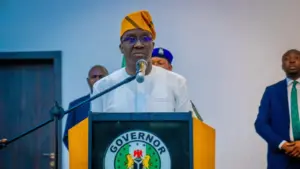
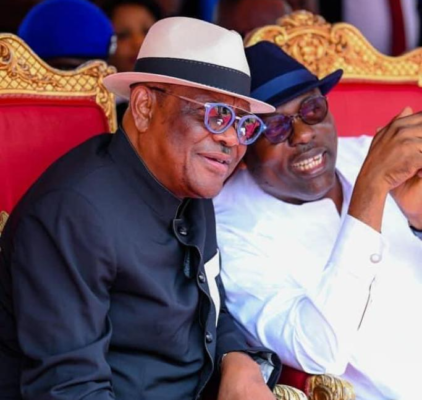
Political fallouts between sitting governors and their political benefactors have become a familiar pattern in Nigeria’s democracy. While such rifts are often anticipated, few observers expected relations to deteriorate so quickly between former Rivers State governor and current Minister of the Federal Capital Territory (FCT), Nyesom Wike, and the man he helped install as his successor, Governor Siminalayi Fubara.
Fubara had been in office for just about five months after his inauguration on Monday, May 29, when signs of a deepening crisis within the state’s political structure spilled into the open.
The tension became public on the night of Sunday, October 29, following reports that the Rivers State House of Assembly complex was set on fire amid moves linked to an alleged impeachment plot against the governor.
By Monday morning, October 30, the situation escalated further as Governor Fubara arrived at the Assembly complex to assess the damage.
He confirmed the incident and went on to raise serious concerns, alleging threats to his life, including claims involving security agencies.
The unfolding drama in Rivers State has once again drawn attention to a recurring trend in Nigerian politics, where alliances forged during elections often collapse shortly after power changes hands.
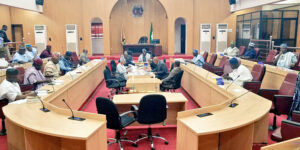
on Thursday, January 8, the Rivers State House of Assembly presented notice of allegations of gross misconduct against the Governor and Deputy Governor of the State.
Relying on Section 188 of the 1999 constitution as amended and other extant laws, the Leader, Major Jack read the notice against the Governor while the Deputy Leader Linda Stewart read the notice against the deputy governor.
The major points in both notices revolve around non presentation of the Budget, spending state funds without legislative approval, withholding of salaries and funds accruing to the Rivers State House of Assembly, the clerk and the Assembly Service Commission, non screening of government appointments by entities other than the legitimate House of Assembly and the demolition of the assembly complex.
The 26 lawmakers allege that the governor and his deputy have shown that they lack capacity to perform their constitutional duties.
Martin Amaewhule, Speaker, Rivers State House of Assembly, while speaking during the plenary said: “Rivers State Governor Siminalayi Fubara is a mistake. We will follow this impeachment process through.”
READ ALSO: BREAKING: Rivers Assembly Begins Impeachment Proceedings Against Fubara, Deputy
Several former governors across the country have similarly fallen out with their predecessors after assuming office. Below are few of them:
- Rabiu Kwankwaso vs Abdullahi Ganduje
For years, former Kano State Governor Senator Rabiu Kwankwaso enjoyed a close relationship with his successor, ex-Governor Abdullahi Ganduje. Ganduje served as Kwankwaso’s deputy twice, from 1999 to 2003 and again from 2011 to 2015. Their alliance deepened further between 2003 and 2007, when Kwankwaso served as Minister of Defence and Ganduje worked closely with him.
Read Also
However, their relationship began to unravel shortly after Ganduje assumed office in 2015, when he submitted his cabinet list to the state House of Assembly for confirmation. Many of Kwankwaso’s loyalists felt sidelined, accusing Ganduje of excluding them from key positions.
Attempts to manage the tension failed, eventually escalating into a full-blown rivalry. This culminated in the 2019 governorship election, where Kwankwaso’s endorsed candidate, Kabiru Abba Yusuf, contested against Ganduje and lost under what many described as “controversial circumstances.”
The feud continued into the 2023 election, with Kwankwaso backing Yusuf once again, while Ganduje supported Nasir Yusuf Gawuna. Although Yusuf was initially declared the winner by the Independent National Electoral Commission (INEC), a tribunal later nullified the result, a ruling that has since been appealed.
2. Godwin Obaseki vs Adams Oshiomhole
Former Edo State Governor Godwin Obaseki also experienced a high-profile fallout with his predecessor and former mentor, Senator Adams Oshiomhole.
Obaseki, who had been a key member of Oshiomhole’s cabinet, initially secured the former governor’s support to contest and win the 2016 governorship election under the All Progressives Congress (APC).
The relationship later soured when Obaseki defected to the Peoples Democratic Party (PDP) to pursue a second-term bid after being disqualified from the APC primaries.
Oshiomhole, widely reported to have played a role in Obaseki’s disqualification amid their growing rivalry, threw his support behind Osagie Ize-Iyamu.
Despite this, Obaseki went on to win reelection, marking a decisive break from his former mentor.
3. Peter Odili vs Rotimi Amaechi
Former Rivers State Governor Dr. Peter Odili in 2014 publicly expressed regret for having supported Rotimi Amaechi’s rise to the governorship. Odili accused Amaechi of dismantling the political structures established by the founding fathers of the PDP in the state once he assumed office.
Amaechi, who served as governor from 2007 to 2015, had been a close ally and political godson of Odili. Reflecting on his support, Odili said: “With all the best intentions, we supported his political career and ambition. We thought we did what was best for the state. One thing is clear, we have accepted our mistake and we are determined to correct it in 2015.”
Amaechi’s actions reshaped Rivers State politics, paving the way for the alliance between Odili and Nyesom Wike, which later facilitated Wike’s emergence as governor.