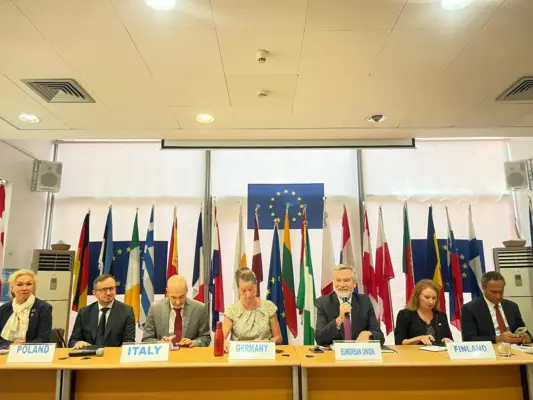
The European Union (EU) ambassador to Nigeria and the Economic Community of West African States (ECOWAS), Gautier Mignot, has disclosed that the the bloc is actively supporting Nigeria’s fight against banditry and insecurity and funding peace-building initiatives across the country.
Mignot, while speaking in Abuja during an end-of-year media briefing on the EU’s engagements and achievements in Nigeria, on Wednesday, December 03, noted that the spotlight has been high on insecurity in recent times, and has been “for good reasons”.
“But there are others like poverty and social inequalities. We also have been insisting very much on the need to urgently tackle with humanitarian and life-saving assistance the malnutrition crisis affecting, particularly, hundreds of thousands of children in north-west and north-east,” he said.
“Protecting all populations, and in particular minorities and IDPs, is particularly essential. This is what we have done in particular after the Yelwata killing in Benue state in June.
READ ALSO: Troops Neutralise 7 Terrorists, Recover Weapons In Borno
“In the north, we have launched a northern package of some €300 million of Team Europe funding.
Read Also
- Nigeria’s Removal from EU Financial High-Risk List to Enhance Access to European Markets – FG
- FG, EU, Sign Agreements to Boost Local Manufacturing, Reproductive Health in West Africa
- EU Provides N320.5B Credit Line to Boost Nigeria’s Agricultural Sector
- EU commits €1.5M to support victims of Yelwata attack, other IDPs in Benue state
“The EU stands with the populations affected by a humanitarian crisis, particularly children and women in the north-west and north-east.
“While the EU may not fill the vacuum left by those who have withdrawn, Nigeria can count on us as its reliable partners for all times. This year alone, we have committed nearly €50 million in humanitarian assistance to address the problem of malnutrition.”
On the sidelines of the event, Mignot stated that it is important to recognise that Nigeria’s insecurity is a complex challenge with many drivers.
“Religion is one, but it’s not the only one,” he said.
“Of course, freedom of religion is a key principle; it must be respected. But there are many other drivers for insecurity and violence in Nigeria.
“What the EU has been doing already for many years, with their member states, is to support Nigeria, both to face insecurity with kinetic and non-kinetic measures and also to address root causes of insecurity, and the 300 million euro package of projects that we have launched this year in north in particular is a response to this.”