
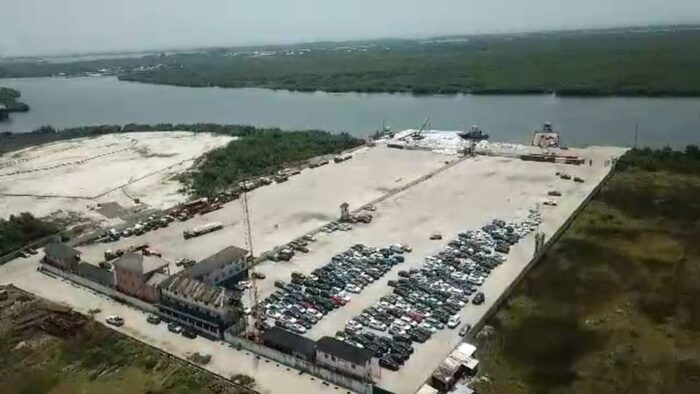
The Chief Executive Officer of Defence Industries Corporation of Nigeria’s DICON-D7G initiative, Osman Chennar, has led members of the board of directors on an inspection visit to the proposed site for Nigeria’s first military jetty, a project aimed at strengthening the country’s indigenous defence production capacity.
Speaking to journalists during the visit, Chennar described the project as a strategic infrastructure that would support Nigeria’s expanding defence manufacturing ambitions.
The proposed jetty, located near Tin Can Island Port, will serve as a dedicated logistics hub for the movement of critical components and materials required for local military hardware production.
According to the DICON-D7G chief executive, the facility will improve Nigeria’s defence logistics chain by enabling the efficient importation of Completely Knocked Down (CKD) and Semi-Knocked Down (SKD) components, raw materials and other supplies needed for large-scale local assembly and manufacturing.
He said the jetty would directly support the production and assembly of small and medium arms, ammunition, tactical drones, unmanned systems, mine-resistant ambush protected vehicles, and anti-jammer drone systems.
Chennar disclosed that the organisation had already commenced production of DG103 rifles in Kaduna State for both Nigerian and African markets.
He added that once completed, the jetty project in Lagos is expected to employ more than 2,000 retired military personnel and about 5,000 skilled civilians while boosting the local production of military-grade weapons and ammunition for the Armed Forces of Nigeria and friendly African countries.
“By strengthening inbound logistics, the jetty will reduce turnaround times, lower transportation costs and streamline supply chain operations, which are critical for scaling up local defence production,” Chennar said.
A member of the board of directors, Mainasara Abdul Masanawa, a retired major general, said the jetty would also serve as an export gateway for finished defence products to allied African nations.




According to him, the development will deepen regional defence cooperation and reinforce Nigeria’s position as a hub for military manufacturing in Africa.
“The project underscores DICON-D7G’s commitment to reducing reliance on foreign sources for defence equipment and strengthening self-sufficiency for the Armed Forces, paramilitary organisations and other security agencies,” Masanawa said.
He added that the initiative aligns with the defence industrial self-reliance objective under the Renewed Hope agenda of President Bola Ahmed Tinubu.
The project is expected to support local technical capacity development, reduce foreign exchange expenditure on defence imports, generate employment and encourage technology transfer.
Officials said the military jetty is scheduled for official launch in June 2026, marking a major milestone in Nigeria’s efforts to build a resilient and self-sustaining defence industrial base.