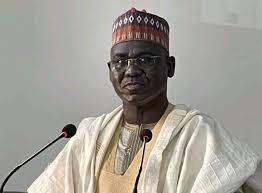
Former Nigeria’s Chief of Army Staff, Lt.-Gen. Tukur Buratai (rtd.), Ambassador to the Republic of Benin, has commended President Bola Tinubu for his swift deployment of military action to crush the attempted coup in the Republic of Benin, describing the action as a “decisive masterstroke” that safeguarded democracy and averted a regional crisis.
Buratai, in a statement in Abuja on Tuesday, expressed that the deployment of Nigerian Air Force jets and ground forces carried out at the request of Benin’s authorities was a display of “strategic foresight, political courage and military efficiency.”
The statement reads, “President Bola Tinubu’s swift and decisive military intervention to crush the coup attempt in the Republic of Benin stands as a bold and commendable act of strategic statesmanship. This rapid deployment of Nigerian Air Force jets and ground forces, executed with precision at the formal request of a neighbour, successfully safeguarded a democracy and averted a dangerous spiral of regional instability.”
Buratai slammed critiques of the intervention for their lack of comprehension of necessary foreign policy, saying, “This essential foreign policy success by juxtaposing it with Nigeria’s protracted internal security battles is to misunderstand the fundamental nature of the threats involved.
“These are not equivalent scenarios demanding a simple choice of one over the other; they are two distinct kinds of warfare, each requiring its own strategic toolkit. The operation in Cotonou was a classic, conventional military engagement against a clear and contained enemy—renegade soldiers holding fixed positions. This type of mission, targeting specific assets like a television station or army camp, plays directly to the established strengths of a national military: superior firepower, air dominance, and disciplined infantry able to dislodge a foe from defined territory. Nigeria’s formidable success here demonstrates a capacity for decisive action that should be a source of national pride.”
Buratai further explained that, “In stark contrast, the fight against banditry and insurgency within Nigeria is a complex, asymmetric war. This conflict is not against a uniformed army but against shadowy, fluid networks of militants deeply embedded within social and economic grievances. These adversaries employ guerrilla tactics, survive on intricate systems of local informants, and offer no clear front line for conventional forces to engage. Victory in such a conflict depends less on a single crushing aerial sortie and more on a sustained, multifaceted campaign combining intelligence, policing, economic development, and social policy—an inherently slower and more complex undertaking. Therefore, praising the efficiency in Benin does not criticise the pace at home; it merely acknowledges that they are different battles entirely. Crucially, the intervention was a masterstroke of preventative security.”
Buratai further argued that, “a successful coup in Benin would have directly threatened Nigeria’s national interest, potentially transforming our western border into a zone of chaos. The resulting power vacuum could have fostered safe havens for the very terrorist and criminal networks we combat domestically, triggering refugee flows and cross-border raids that would have catastrophically compounded our existing security challenges.”
Buratai concluded, saying, “By acting decisively, President Tinubu did not neglect a fire at home to water a neighbour’s garden; he prevented a dangerous wildfire in the adjoining field from spreading to our own compound. This move was not an act of misplaced altruism but one of enlightened self-interest, safeguarding Nigerian stability by ensuring the region remained secure.
It proves that when presented with a clear, conventional threat, Nigeria possesses the political will and military capability to act decisively. This same clarity of purpose must now be relentlessly applied to the intricate, long-term project of securing our homeland, where the tools for success extend beyond the battlefield.”