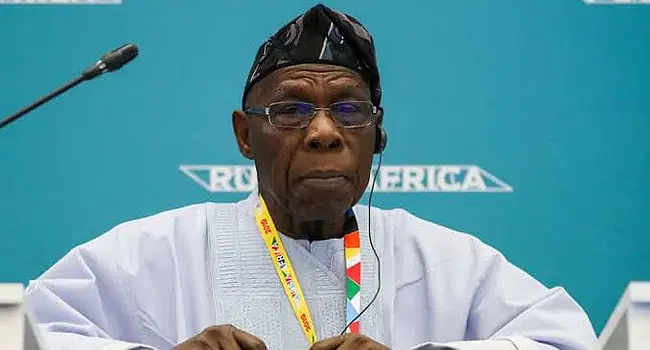
Former President Olusegun Obasanjo has voiced concern over the prolonged Boko Haram insurgency, noting that the conflict has now stretched for 15 years far longer than the Nigerian Civil War, which lasted 30 months.
Speaking on Sunday during a virtual edition of the Toyin Falola Interviews, Obasanjo said the drawn-out insurgency reflects deep structural weaknesses within Nigeria’s security framework.
The conversation also featured Bishop Matthew Hassan Kukah and former Central Bank Deputy Governor Dr. Kingsley Moghalu.
Obasanjo cautioned that Nigeria’s struggles with terrorism and banditry will continue unless the military embraces new approaches, including specialised overseas training, stronger intelligence gathering, and wider deployment of modern technology.
He argued that the country’s military remains oriented toward “conventional warfare,” a model he said is ill-suited for the asymmetric and guerrilla-style conflicts Nigeria now faces.
Obasanjo added that without comprehensive reforms, the nation would continue to struggle against armed groups that have adapted more quickly to the complexities of modern insurgency.
He said, “There are four important items and I hope that those who are in charge both military, executive, and legislature know what they are doing.
“First, there is training. There are different types of training. The military is trained for conventional war and static enemies; you plan, you go there, and you deal with it.
“If the people you are dealing with are fleeting targets or living among your people, you will need different types of training to deal with them.
“Among the countries that have done that fairly successfully is Colombia. Should we invite them to train our people? There is no shame in that. It is a specialised type of training.
“There is the equipment. The equipment to fight, including arms and ammunition to fight that type of warfare, is different from the equipment for conventional warfare.
Read Also
“The third one is intelligence. You need absolute intelligence. Can others trust us with the intelligence that they have? And the fourth one is technology. These four have to come together and do other things internally.
“Then you ask the military to be the one buying equipment. It is not done. The whole thing is an industry. It is an industry.
The former president also expressed concern that the 15-year battle against Boko Haram had lasted even more than the civil war.
“Civil war lasted for 30 months. Although we thought it would last for six months. But this fight against insurgents and criminals has lasted for almost 15 years.”
The former military head of state recalled his 2011 visit to Maiduguri, where he sought to understand Boko Haram’s origins, grievances, and leadership. Obasanjo said the insurgents initially refused to engage in negotiations with the federal government.
He said, “When I went to Maiduguri, my aim was to understand what Boko Haram really was. Are these people real? Do they have leaders? What are their grievances?
“Before leaving, I informed the president of my intention. He offered me a plane, but I declined. I told him that the moment I took a government aircraft, I would be seen as a government agent—and once that happened, I would no longer be trusted. So I went on my own.
“When I arrived, I discovered they were truly an organised group. I also found that their leader, Mohammed Yusuf, was regarded as a decent man, someone even other clergy members had once recommended.
“I asked if they were willing to speak with the government. At first, they said no. When they later agreed to talks, they insisted it could not happen anywhere in Africa. I told them that was impossible; it is an African problem and must be solved in Africa.
“I eventually reported everything to the government, but nothing was done.
“When they later asked how long they had to wait, I appealed to them: ‘Can you cease fire for 21 days while the government works out how to reach you?’ I stepped out, and the government never made contact with them.”