
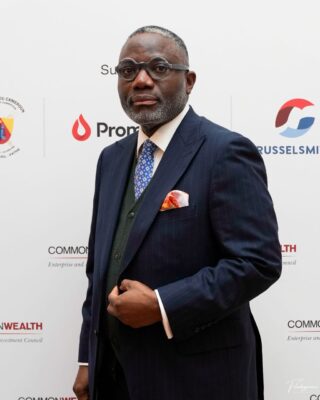
Ogun State Commissioner for Finance and Chief Economic Adviser, Dapo Okubadejo, has called for a pragmatic, Africa-centred approach to energy transition, stressing that energy security and decarbonisation must go hand in hand.
Addressing policymakers, investors, and development experts, at the Commonwealth Trade and Investment Summit in London, Okubadejo challenged the long-standing global narrative that treats energy security and decarbonisation as mutually exclusive. He described the idea as a “false choice,” insisting that Africa’s development requires a strategy that accommodates both priorities simultaneously.
“Energy today is no longer just a sector-it is power, prosperity, and survival,” he said, underscoring the central role energy plays in shaping the continent’s economic future.
Highlighting Africa’s energy deficit, Okubadejo noted that more than 600 million people across the continent lack access to electricity. He described the situation as a development crisis, pointing out that unreliable power continues to constrain businesses, industries, and overall economic productivity.
“You cannot decarbonise darkness,” he added, reinforcing the urgency of addressing energy access as a foundation for sustainable growth.
ADVERTISEMENT
To tackle the challenge, the commissioner proposed a “dual-track energy transition” tailored to Africa’s realities. The strategy advocates immediate efforts to stabilise energy supply-particularly through the use of domestic gas resources and improved infrastructure – while also advancing long-term investments in renewable energy, storage technologies, and smart grid systems.
Central to his proposal is the principle of sequencing. Okubadejo argued that energy security must come first to create the conditions necessary for effective and sustainable decarbonisation. Attempting to reverse this order, he warned, could lead to economic disruption and policy setbacks.
Read Also
He also called for a broader understanding of energy security, moving beyond supply concerns to include affordability, reliability, sustainability, and strategic autonomy. While acknowledging the importance of transitioning to clean energy, he cautioned that the shift introduces new risks, including supply chain vulnerabilities and grid instability.
Beyond outlining challenges, Okubadejo identified key priorities for Africa’s energy future. These include building resilient and flexible energy systems, improving energy efficiency, securing critical supply chains, leveraging gas as a transition fuel, and strengthening governance and regulatory frameworks.
He emphasised that strong institutions and consistent policy direction are essential to attracting investment and ensuring long-term success in the energy sector.
ADVERTISEMENT
Calling for stronger international cooperation, Okubadejo urged global partners to support Africa with fair financing, technology transfer, and equitable transition frameworks that align with the continent’s development goals.
“Africa did not create the climate crisis, but it must be part of the solution,” he said, stressing the importance of partnerships that enable growth rather than impose limitations.
He concluded by positioning Africa as a potential leader in the global energy transition, provided the right policy and investment decisions are made.
“The future will not be powered by ideology,” Okubadejo said. “It will be powered by decisions.”