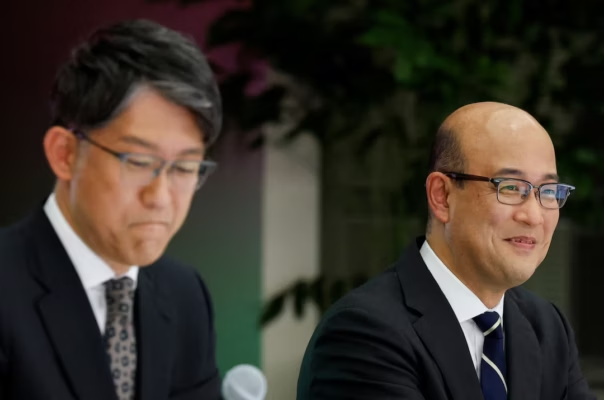
Toyota Motor Corporation on Friday announced that its finance chief, Kenta Kon, a close ally of Chairman Akio Toyoda, will succeed Koji Sato as the automaker’s next chief executive.
The move comes as the world’s largest automaker faces intensifying competition from fast-moving Chinese rivals.
Sato, who has led Toyota for just three years, will step down on April 1 to become vice chairman and take on the newly created role of chief industry officer. Under the new structure, Kon will focus on internal management, while Sato will concentrate on broader industry initiatives.
As Toyota’s chief financial officer, Kon is known for his strict cost management. The surprise leadership reshuffle coincides with growing scrutiny over Toyota’s planned buyout of its forklift subsidiary, Toyota Industries, a deal minority investors have criticised as “lacking transparency and being significantly underpriced.”
The announcement came alongside Toyota’s third-quarter earnings report, which showed a nearly 12% increase in full-year profit outlook, driven by a weaker yen and cost-cutting measures.
READ ALSO: Shell CEO Hails Tinubu’s Leadership, Pledges $20B Additional Investment
“Kon, I think he basically has more experience dealing with the financial issues of the company than Sato-san, who basically came from the product development side,” said James Hong, head of mobility research at Macquarie, noting that Kon was viewed as the “mastermind” behind the forklift buyout.
Kon, who also oversees finances at Toyota’s mobility technology subsidiary Woven by Toyota, said he was “surprised” when first approached about the CEO role in mid-January. His background in finance and mobility technology is expected to help Toyota close its software gap with Chinese competitors.
Before rising through the accounting department, Kon served as head of Toyota’s secretarial department while Akio Toyoda was CEO. Toyoda, the founder’s grandson, led the company for nearly 15 years before appointing Sato as his successor.
Toyota’s continued focus on gasoline-electric hybrids has supported record sales, helping the company maintain its position as the world’s top-selling automaker last year.
During Sato’s tenure, Toyota shares have risen 111%, including dividends, outperforming the Nikkei index, though the company has lost some market share in regions such as Southeast Asia to agile Chinese rivals like BYD.
The management transition underscores Toyota’s growing recognition of the need for financial and strategic oversight alongside product innovation.
As Hong observed, “the change likely reflected the automaker’s awareness of the many more decisions to be made around the non-automotive businesses.”