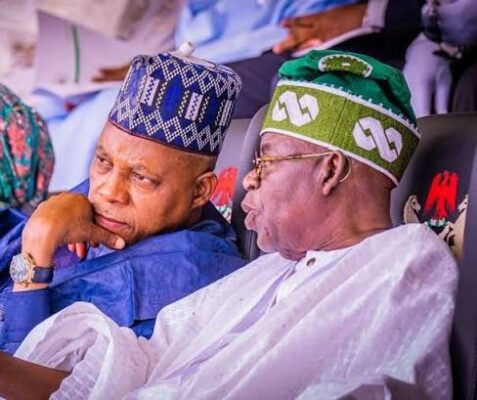
Vice President Kashim Shettima has disclosed that some individuals from Borno State once advised President Bola Tinubu to stop wearing traditional outfits he gifted him during the 2023 election campaign, alleging that the clothes had been charmed to influence him.
Shettima, however, said Tinubu dismissed the claims and continued wearing the outfits deliberately for an entire week to prove there was nothing mystical about them.
The Vice President made the revelation on Tuesday in Abuja while representing Tinubu at the public presentation of My Life of Duty and Allegiance, the autobiography of former Head of State, General Yakubu Gowon.
Speaking on what he described as the growing mistrust in Nigerian society, Shettima contrasted the current atmosphere with the relationship that once existed between Gowon and the family of the late Sultan Muhammadu Sa’ad Abubakar III.
ADVERTISEMENT
He recounted how the Sultan’s family regularly sent gallons of fura to Gowon during his time in Dodan Barracks without any fear or suspicion.
“His Eminence, the Sultan of Sokoto, had been narrating the story of the family of the Sultan sending gallons of fura every week to General Yakubu Gowon in Dodan Barracks, because of the trust and confidence General Gowon was willingly receiving it without any suspicion.
“But now the game is different. Suspicion smears our relationships, and it ought not to be. We are essentially one people tied to a common destiny,” Shettima said.
The Vice President explained that during the 2023 presidential primaries, he personally sourced traditional Borno outfits and caps for Tinubu to wear while campaigning across Northern Nigeria.
According to him, the attire became popular and was frequently worn by Tinubu throughout the campaign period.
ADVERTISEMENT
Shettima said the controversy emerged after the administration assumed office, following his return from Beijing, China, where he represented the President at the Third Belt and Road Initiative Forum in October 2023.
Read Also
He said Tinubu later informed him that some visitors from Borno had warned him against continuing to wear the clothes.
“When I came back from China, where I had represented him at the Belt and Road Initiative Conference, he said: ‘Sit down. Your people came to me and said I should stop wearing those dresses you gave me. They said I must have been charmed, and that I am going to die and he will become the president,’” Shettima recounted.
According to the Vice President, Tinubu immediately dismissed the allegation, insisting the claim made no sense because the outfits were given to him before both of them emerged as the party’s presidential and vice-presidential candidates.
“Their story did not add up, because when you gave me those dresses, I was an aspirant. I wasn’t even the candidate. Neither were you the vice-presidential candidate,” Shettima quoted Tinubu as saying.
ADVERTISEMENT
He added that the President intentionally continued wearing the traditional attire to counter the rumours.
“For one week, to prove to them that he is not fetish, he wore those dresses.
“These are some of the gimmicks that are taking place in power circles in Nigeria nowadays,” he added.

Shettima also praised Gowon for his statesmanship and contributions to national unity, saying the former Head of State represented a different era of leadership defined by trust and patriotism.
He highlighted Gowon’s role in establishing the National Youth Service Corps and his contribution to the formation of the Economic Community of West African States (ECOWAS).
ADVERTISEMENT
Describing Gowon as “the last man standing” among Nigeria’s post-independence military leaders, Shettima said the memoir serves as “a bottom of memory at a time when our country needs a discipline of remembrance.”