
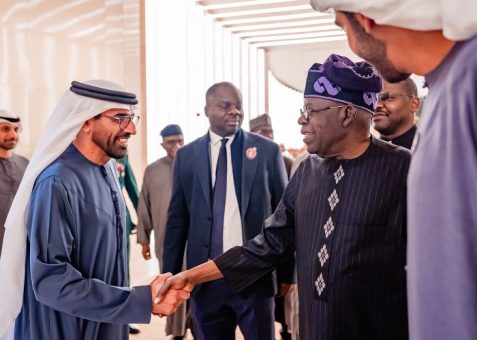
Nigeria and the United Arab Emirates are preparing to take their economic relationship to a new level with the planned signing of a Comprehensive Economic Partnership Agreement during a high-level meeting in Abu Dhabi.
The deal is expected to be concluded when President Bola Ahmed Tinubu holds talks with UAE President Mohammed bin Zayed Al Nahyan on the sidelines of the ongoing Abu Dhabi Sustainability Week. Once signed, the agreement will provide a formal framework for trade and investment between both countries, offering stronger guarantees for businesses and encouraging fresh capital inflows.
The UAE is already one of Nigeria’s most important commercial partners, and officials say the new pact could unlock investments estimated at over $10 billion, particularly in energy, manufacturing, agriculture and infrastructure. Trade in non-oil goods between the two countries stood at $4.3 billion in 2024.
Nigeria’s Minister of Foreign Affairs, Yusuf Tuggar, speaking to journalists in Abu Dhabi, described the agreement as a key outcome of President Tinubu’s participation at the sustainability summit. According to him, UAE investors have been keen on seeing the pact finalised to ensure certainty and legal protection for their operations in Nigeria.
He said: “President Tinubu is going to have a bilateral meeting with President Nahyan.
“One of the things to be discussed there is the Comprehensive Economic Partnership Agreement, which is expected to be signed during that bilateral meeting.”
Tuggar added that the deal is not only about attracting Emirati capital but also about protecting Nigerian entrepreneurs operating in the UAE.
READ ALSO: EXPLAINER: What Benefits Await Nigerian Youths In Nigeria-UAE Digital Education Partnership
“It also protects the investments of Nigerians. We have a lot of Nigerian businesses in Dubai. Some actually even have factories.
“This further protects them, dignifies the Nigerian and ensures that Nigerians are respected wherever they go to invest or visit,” he said.
Read Also
Energy, especially gas-to-power projects, has been identified as a major pillar of the partnership. Tuggar noted that Nigeria’s huge gas reserves remain underutilised for electricity generation, contributing to the country’s long-standing power shortages.
“We’re looking to invest further in gas for electricity. We have a lot of gas, and we need to develop it to generate electricity.
“That is why we now have a lot of pipelines being constructed and a licensing round going on for acreage,” he said, adding that the agreement would also encourage more exploration and production activities.
Beyond energy, the CEPA is expected to deepen trade in agricultural products and manufactured goods, while also strengthening financial and aviation links. Tuggar recalled that issues around trapped airline funds, which had previously disrupted operations, were resolved after President Tinubu took office, improving travel and payments between both countries.
He also explained that Nigeria’s presence at Abu Dhabi Sustainability Week is aimed at turning climate promises into real projects.
“This presents an opportunity to come with identified projects and try to source funding from some of the countries and organisations that are in attendance,” Tuggar said.
According to him, President Tinubu will use his address at the forum to outline Nigeria’s climate priorities and investment-ready projects.
“He will talk about Nigeria’s focus in terms of deliverables, our goals and commitments, and ensuring that the projects we bring forward are viable and can convince funders,” he added.
Nigeria and the UAE have already made significant progress in recent years, sealing 14 investment agreements worth $5 billion in 2024. The two countries also recently signed a memorandum of understanding on digital education and skills development, aimed at equipping Nigerian youth through the Nigerian Youth Academy with globally relevant digital capabilities.