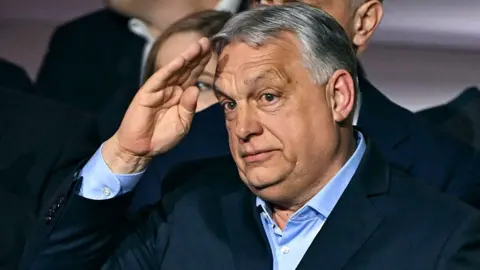
There is a tendency, in moments like this, to reduce political change to electoral arithmetic. Seats won. Votes counted. Governments formed. But what has just occurred in Hungary resists such simplicity. The defeat of Viktor Orbán after sixteen years in power is not just a transition. It is a reckoning.
For over a decade and a half, Orbán did not merely govern Hungary; he reshaped it. He constructed what he famously described as an “illiberal democracy”. This is a system where electoral legitimacy coexisted with the steady centralisation of power. Media ecosystems were aligned, judicial independence questioned, and economic networks increasingly intertwined with political authority. It was, in many respects, a model that outlived its early sceptics.
And yet, it fell. Not abruptly. It fell predictably!
ADVERTISEMENT
When Economic Reality Overtakes Political Narrative
Political systems endure not simply on ideology, but on performance. Orbán’s longevity rested on a tacit social contract: national assertiveness in exchange for economic stability. That equilibrium, once disrupted, proved decisive.
Inflation, declining purchasing power, and broader economic fatigue did what opposition fragmentation could not achieve for years. They eroded trust. Voters who once tolerated centralised authority in exchange for predictability began to reassess the bargain. This is the quiet truth of democratic politics: citizens may accommodate strong leadership, but they rarely forgive sustained economic discomfort.
ADVERTISEMENT
The Emergence of a Credible Alternative
Equally significant was not just that Orbán weakened, but that an alternative strengthened. The rise of Péter Magyar a figure with insider knowledge of the system, altered the political equation.
He did not campaign as a disruptor from the margins, but as a reformer from within. His message, anchored in anti-corruption, institutional repair, and renewed European alignment, offered something the Hungarian electorate had not seen in years: plausibility. Elections are rarely won on dissatisfaction alone. They are won when dissatisfaction meets credibility.
ADVERTISEMENT
A European Rebalancing, Not a European Revolution
For the European Union, Hungary has long represented a paradox: a member state that persistently challenged the Union’s core democratic norms while remaining structurally embedded within it.
Orbán’s departure may ease tensions, unlock frozen EU funds, and signal a “return to Europe” in diplomatic terms. But it would be a mistake to interpret this moment as the end of populist politics on the continent. The forces that sustained Orbán, which are identity anxiety, migration pressures, economic insecurity, have not disappeared. They remain embedded across Europe’s political landscape. What Hungary demonstrates is not the defeat of populism, but its vulnerability when it ceases to deliver materially and overextends institutionally.
ADVERTISEMENT
The Harder Task: Governing After Dominance
There is a temptation to frame this moment as a democratic triumph. It is. But just partially. The deeper test lies ahead.
Sixteen years of political dominance do not dissolve with one election. Institutional loyalties, media structures, and economic alignments built over time do not reset overnight. The incoming administration inherits not a neutral state, but a shaped one.
ADVERTISEMENT
The challenge, therefore, is not merely to govern but to rebalance without revenge. To restore institutional credibility without replicating the very excesses that defined the previous era. Democratic renewal is not secured by victory. Such renewal is secured by restraint.
Lessons Beyond Hungary: A Mirror for Emerging Democracies
For observers beyond Europe, particularly in Africa, Hungary’s moment offers a set of quiet but powerful lessons.
ADVERTISEMENT
First, no political dominance is permanent. Longevity in power, often mistaken for legitimacy, is ultimately contingent.
Second, economic performance remains the most enduring currency of political trust. Rhetoric may mobilise, but reality decides.
ADVERTISEMENT
Third, institutions matter. Where they are weakened, recovery becomes harder, but not impossible.
For countries like Nigeria, where democratic structures continue to evolve under pressure, the Hungarian experience is a reminder that democracy is neither self-executing nor self-sustaining. It must be continually renewed, through accountability, performance, and credible alternatives.
The Deeper Meaning of the Moment
ADVERTISEMENT
What Hungary has offered the world is not a spectacle, but a signal. That even systems carefully engineered for durability remain vulnerable to citizen judgment. That political authority, however entrenched, is ultimately conditional. And that democracy, though often strained, retains a remarkable capacity for self-correction.
The fall of Viktor Orbán is therefore not the end of a political era alone. It is a reminder of a foundational principle: Power, in a democracy, is never owned. It is only ever held in trust.
Opinion piece sent in by Collins Nweke
ADVERTISEMENT