
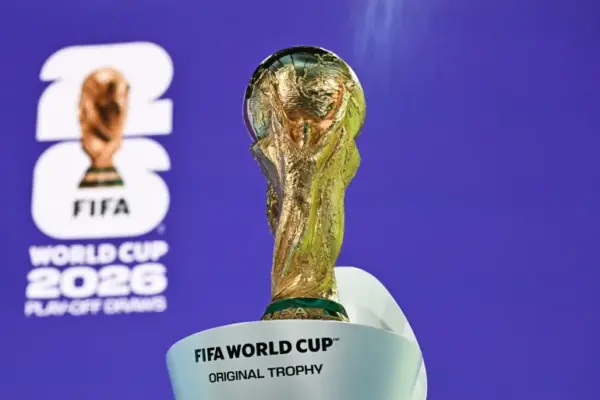
The draw for the inaugural 48-team FIFA World Cup will take place on Friday, December 5, at the John F. Kennedy Center for the Performing Arts in Washington, DC.
The tournament itself will run from June 11 to July 19, 2026, across the United States, Mexico, and Canada.
The draw begins at 12:00 noon local time (17:00 GMT).
Draw Format and Top Seeds
Teams are divided into four pots of 12 based on FIFA rankings. The draw will start with Pot 1, featuring the 12 seeded teams, which include:
Top four-ranked nations: Spain, Argentina, France, and England
Next five best-seeded nations: Belgium, Brazil, Germany, Netherlands, and Portugal
Three host nations: United States, Mexico, and Canada
The remaining pots—2, 3, and 4—will be drawn in order to complete the 12 groups (Groups A to L). Six World Cup spots are still up for grabs through playoffs in March. Notably, Italy, four-time World Cup winners and 12th in the FIFA rankings, could end up in Pot 4 if they qualify. Debutants Uzbekistan are in Pot 3, while Jordan, Cape Verde, and Curacao are in Pot 4.
Draw Mechanics
Each nation’s name is printed on a slip of paper, folded, and placed inside a numbered plastic ball corresponding to its pot. The balls are mixed in large glass bowls and drawn one at a time to form the groups.
Keeping Top Seeds Apart
For the first time, FIFA has designed the draw so that the four highest-ranked nations—Spain, Argentina, France, and England—cannot meet before the semifinals, provided they top their groups. No group can include more than one team from the same confederation, except UEFA, which will have 16 teams. This means four groups will contain two European nations.
The 2026 World Cup draw places the top four teams in separate quadrants of a new seeded bracket. FIFA confirmed that “the top four nations, if they finish top of their respective round-robin groups, will avoid each other until the semifinals.” Defending champions Argentina and Spain, for example, could meet only in the final at MetLife Stadium near New York.
Host Nations Assigned to Groups
United States: Group D, playing two matches in Los Angeles and one in Seattle
Mexico: Group A, with two games at the Azteca Stadium—including the opening match on June 11—and one in Guadalajara
Canada: Group B, hosting one game in Toronto and two in Vancouver
READ ALSO: FULL LIST: Countries That Qualified For 2026 World Cup So Far
Expanded Tournament and Knockout Format
Read Also
With 50% more teams than the 2022 edition, the tournament introduces an extra knockout round. The round of 32 will include the top two teams from each group plus the eight best third-placed teams. Across the 72 group-stage matches, only 16 teams will be eliminated.
Teams by Seeding
Pot 1: United States, Mexico, Canada, Spain, Argentina, France, England, Brazil, Portugal, Netherlands, Belgium, Germany
Pot 2: Croatia, Morocco, Colombia, Uruguay, Switzerland, Japan, Senegal, Iran, South Korea, Ecuador, Austria, Australia
Pot 3: Norway, Panama, Egypt, Algeria, Scotland, Paraguay, Tunisia, Ivory Coast, Uzbekistan, Qatar, Saudi Arabia, South Africa
Pot 4: Jordan, Cape Verde, Ghana, Curacao, Haiti, New Zealand, 4 UEFA play-off winners, 2 Intercontinental play-off winners
Playoff Pathways
UEFA Play-Offs (16 teams, four paths, one qualifier per path)
Path A: Wales or Bosnia & Herzegovina v Italy or Northern Ireland
Path B: Ukraine or Sweden v Poland or Albania
Path C: Slovakia or Kosovo v Turkey or Romania
Path D: Czech Republic or Ireland v Denmark or North Macedonia
Dates: Semi-finals March 26, finals March 31
Intercontinental Play-Offs (6 teams, two paths)
Path 1: New Caledonia or Jamaica v DR Congo
Path 2: Bolivia or Suriname v Iraq
Dates: Semi-finals March 26, finals March 31, all matches in Mexico
How to Watch
Live coverage of the draw will be available on FIFA.com, FIFA World Cup social media channels, and through FIFA’s media partners.
With the expanded 48-team format, fans can expect a record number of matches, exciting new group dynamics, and the debut of fresh nations on football’s biggest stage.