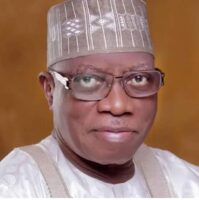

In recent public discourse, the write-up of some Ibadan Mogajis, on the actions and utterances of the Olubadan of Ibadanland, His Imperial Majesty, Oba Rasheed Adewolu Ladoja, Arusha I have attracted widespread commentary, some of it critical and, in places, unfairly judgmental.
A video went viral, capturing a tense moment between the Alaafin of Oyo, Oba Akeem Owoade, and the Olubadan of Ibadanland, Oba (Sen.) Rashidi Ladoja, which sparked a fresh public debate on Monday during the 2026 Inter-Faith service held at the Secretariat’s Grand Space, behind the Oyo State House of Assembly, Ibadan.
The video cited by TVC News during the event showed the Alaafin, who was seated when he extended his hand in greeting to the Olubadan, but Oba Ladoja snubbed the gesture just a few seconds after exchanging pleasantries with the Soun of Ogbomoso, Oba Afolabi Ghandi Olaoye.
The Olubadan subsequently greeted Governor Seyi Makinde and other dignitaries before proceeding to his seat, a moment that was witnessed by several attendees at the gathering.
In a Wednesday statement signed by Career Ambassador Ambassador Tunde Mustapha, he noted that it is important, however, to state clearly and without equivocation that the Olubadan deserves neither blame nor vilification.
Mustapha explained that Olubadan’s conduct should be understood within the proper historical and psychological context of Ibadan’s unique political culture.
Mustapha wrote, “To understand Ibadan is to understand warriors. Ibadan was founded by warriors, sustained by warriors, and governed by warriors. Every leader of Ibadan, from its formative years to the present day, is either a warrior or the son of warriors. Ambition, therefore, is not an aberration in Ibadan politics; it is its defining character. As the popular saying goes, “Ìjà ìgbòrò ni t’Ibadan”—Ibadan is forged in conflict. Turmoil, contestation, and assertion have historically been part of its political DNA.
“From a historical perspective, whenever a warrior emerged as the dominant leader in Ibadan, his ambition rarely stopped at local authority. The next logical aspiration was always an imperial title from Oyo, the source of ultimate legitimacy in the old Yoruba political order. These ambitions were pursued through a combination of diplomacy, negotiation, pressure, and, at times, open defiance. The Alaafin of Oyo, as sovereign, sometimes acceded to these demands and sometimes firmly refused.
“History offers ample precedents. Iba Oluyole, following the death of Oluyedun and the civic murder of Lakanle, became the undisputed lord of Ibadan. As a warrior, and true to Ibadan tradition, he rejected installation as Baale—a civil authority unsuited, in his view, to a man of war.
“He appealed to his cousin in Oyo, Alaafin Atiba Atobatele. Oluyole journeyed to Oyo. In the tradition of that time, he would remove his agbada and ileke, prostrate seven times before his sovereign, before presenting his request. Atiba installed Oluyole as the Basorun of the Empire, then a far higher title than Baale. At about the same time, Kurunmi of Ijaye was granted the title of Aare Ona Kakanfo.”
Mustapha added that, “Balogun Ogunmola, who was Otun Balogun to the famed Ibikunle ‘Kiniun Onibudo,” followed the same path. He refused the Baaleship, went to Oyo, performed dobale, and was installed as Basorun, second only to the Alaafin himself. Latoosa, after consolidating power in Ibadan, also rejected the Baaleship. Though Alaafin Adelu denied him the title of Basorun, he was granted the formidable title of Aare Ona Kakanfo. Basorun Fajinmi similarly negotiated his own imperial elevation.”
Mustapha further noted that not all ambitions were rewarded, explaining that leaders such as Orowusi, Shittu, and Oyesile Foko were denied imperial titles and remained Baales of Ibadan.
Ambassador Mustapha noted that Shittu’s case is particularly instructive, adding that despite his high pedigree as the son of Aare Latoosa, his arrogance and lack of diplomacy proved costly.
Mustapha wrote, “He was afraid of Alaafin Siyanbola Ladigbolu, who the colonial administration had greatly empowered as a result of their indirect rule policy. He claimed he would not eat Ooyo (ewedu), not to mention going to Oyo. Eventually, he was sent to Oyo by the resident, Captain Ross, ‘dobale’ for his sovereign and forced to eat Ooyo while in Oyo. He was deposed and sent to Igbo Oloogun near Shaki to die in exile. Oba Siyanbola Ladigbolu oriki was expanded by this incident to include: “Ládìgbòlù mú Shuittu Ìbàdàn, bí ẹ ń mú adìẹ ìdájí, ó mú Elékòó, bí ẹni fàgbébọ̀ sẹbọ”.
“Baale Shittu’s refusal to acknowledge the authority of Alaafin Siyanbola Ladigbolu, emboldened by colonial backing, led to his humiliation, deposition, and death in exile.”
The Ambassador further disclosed that, “By the late colonial period, the dynamics had shifted. Traditional power waned as colonial authority rose. Baale Abass Aleshinloye, navigating this new reality, negotiated not with Oyo alone but with the colonial government, which eventually prevailed upon the Alaafin to grant him the title of Olubadan in 1938.
“Thus was born the modern Olubadan institution. Ibadan had to wait for three more decades and 10 Olubadans and the wisdom and diplomacy of Alaafin Lamidi Olayiwola Adeyemi III, who moved a motion at the Oyo State Council of Obas and Chiefs meeting on December 7, 1976, to grant Olubadan of Ibadan, Oba Gbadamosi Adebimpe and his successors-in-title the perpetual rights to wear the beaded crown.”
Mustapha reflected on Oba Rasheed Adewolu Ladoja’s ascent, stressing that against this long and complex backdrop, his journey must be viewed.
He said, “From his installation as Jagun in 1993, he followed tradition meticulously, performing dobale before successive Olubadans for over three decades as he ascended the ladder. This was the established order. When the Oyo State Government, under Governor Seyi Makinde, introduced a structural change in 2023 by installing ten Olubadan-in-Council members as Obas, Oba Ladoja resisted—first traditionally, then legally—before eventually yielding.
“The psychological reality today is unprecedented. As Olubadan, Oba Ladoja now presides over a council where other Obas, formerly his subordinates, no longer dobale but merely rise in courtesy. Traditionally, no Oba prostrates for another Oba.
“This is not a question of pride alone; it is a profound psychological shift rooted in centuries of custom. It is within this context that his current posture and quest for clarity in traditional hierarchy should be understood.”
He added that, “Ambition, however, has its limits, and Kabiyesi himself has acknowledged this. He has rightly stated that he harbours no ambition to become “Olubadan of Yorubaland” or “Olubadan of Oyo State.” Such titles do not exist. Only the Alaafin of Oyo can bestow imperial Yoruba titles.
“He cannot aspire to be Olubadan of Oyo state, because the state belongs to Oyo, Ibadan is just the capital city. Of course, Olubadan can aspire and should aspire to become Olubadan of Ibadan State. For this, he doesn’t need to negotiate in Oyo, but he may need to negotiate and ‘dobale’ for another Oyo man in faraway Aso Rock.”
In conclusion, Ambassador Mustapha explained that Oba Rasheed Adewolu Ladoja is not acting out of defiance or excess, stressing that “he is acting true to type: as an Ibadan man, a son of warriors, shaped by history, tradition, and the complex psychology of power.”
“To judge him without this understanding is to misread Ibadan itself. History counsels patience, context, and respect—for in Yoruba polity, nothing exists in isolation from the past,” Mustapha concluded.