
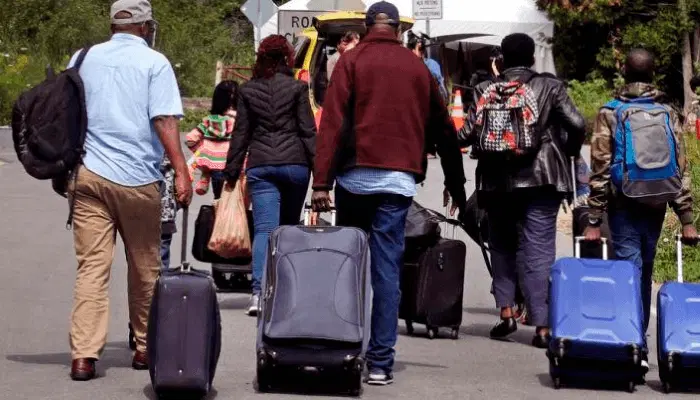
Canada deported 366 Nigerian nationals between January and October 2025 as immigration authorities stepped up enforcement to levels not recorded in more than a decade, official records have shown.
Data from the Canada Border Services Agency (CBSA) removals programme indicate that, in addition to those already deported, 974 Nigerians are currently classified as “removal in progress,” meaning they are awaiting deportation.
The figures were last updated on November 25, 2025.
The statistics placed Nigeria ninth among the 10 countries with the highest number of deportees during the period under review, while it ranked fifth among nationalities with the largest number of pending removals.
A review of historical data shows that deportations of Nigerians from Canada have fluctuated over the years. In 2019, 339 Nigerians were removed, before the figure dropped to 302 in 2020, 242 in 2021 and 199 in 2022.
Nigeria did not feature among the top 10 deported nationalities in 2023 and 2024 but returned to the list in 2025, with 366 removals recorded within 10 months about an eight per cent increase compared with 2019.
READ ALSO: Ghanaian Govt Deports 42 Nigerians Over Prostitution, Fraud, Other Serious Crimes
The rise in removals is occurring against the backdrop of a broader enforcement drive by Canadian authorities. The CBSA is now removing nearly 400 foreign nationals every week, the highest weekly rate in over 10 years.
In the 2024–2025 fiscal year alone, Canada deported 18,048 people at a cost of approximately $78m.
Under the Immigration and Refugee Protection Act, the CBSA is legally required to remove foreign nationals subject to enforceable removal orders.
Individuals may be found inadmissible for reasons including security issues, human or international rights violations, criminal conduct, organised crime, health or financial concerns, misrepresentation, or breaches of immigration rules.
Available data show that failed refugee claimants account for the majority of removals, representing about 83 per cent of cases, while removals linked to criminality make up roughly four per cent.
Canadian law provides for three types of removal orders: departure orders, which require individuals to leave within 30 days; exclusion orders, which bar re-entry for between one and five years; and deportation orders, which permanently prohibit return unless special permission is granted.
Read Also
The Canadian government has said the intensified deportation campaign is aimed at meeting stricter immigration targets and addressing pressures related to housing shortages, labour market challenges and border security.
To that end, Ottawa has allocated an additional $30.5m over three years to support removals and committed $1.3bn to strengthen border security.
The President of the Canadian Association of Refugee Lawyers, Aisling Bondy, has warned that deportations could rise further if Bill C-12, widely referred to as the “border bill,” is passed.
“One of the clauses in that bill is that a lot of people will be permanently banned from filing a refugee claim in Canada,” Bondy said.
An analysis of CBSA figures shows that Nigeria is the only African country among the top 10 nationalities deported in 2025. Other African countries are grouped under “remaining nationals,” which collectively accounted for 6,233 removals during the year.
The countries with the highest number of deportations in 2025 are Mexico (3,972), India (2,831), Haiti (2,012), Colombia (737), Romania (672), the United States (656), Venezuela (562), China (385), Nigeria (366) and Pakistan (359).
A similar trend appears in the list of individuals awaiting removal. Nigeria, with 974 people in the pipeline, is again the only African country in the top 10.
India leads with 6,515 cases, followed by Mexico (4,650), the United States (1,704), China (1,430), Nigeria (974), Colombia (895), Pakistan (863), Haiti (741), Brazil (650) and Chile (621).
Despite the increase in deportations, Canada remains a major destination for Nigerians seeking better educational and economic opportunities.
The 2021 Canadian census showed that more than 40,000 Nigerians migrated to the country between 2016 and 2021, making them the largest African migrant group and the fifth-largest group of recent immigrants overall.
Further figures from Immigration, Refugees and Citizenship Canada indicate that 6,600 Nigerians became permanent residents within the first four months of 2024, ranking fourth behind India, the Philippines and China.
Between 2005 and 2024, a total of 71,459 Nigerians acquired Canadian citizenship, placing Nigeria 10th among countries of origin for new citizens.