Today, January 15, 2026, marks exactly 60 years since the events of the 1966 first military coup in Nigeria, a day observed as Armed Forces Remembrance Day, specifically chosen to commemorate and honour the sacrifices of the military.
A day meant to honour members of the Nigerian Armed Forces who died in the two World Wars, the Nigerian Civil War, and various peacekeeping and internal security operations.
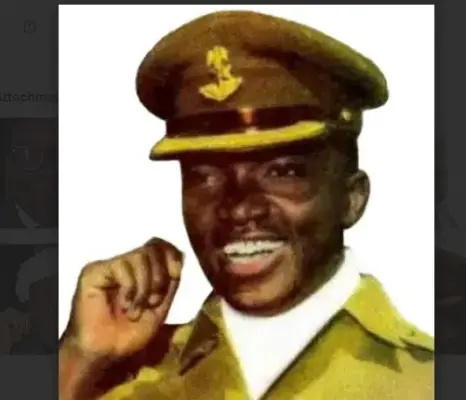
The first military plot led by Major Patrick Chukwuma Kaduna Nzeogwu changed the course of Nigerian history forever.
The coup brought an end to the post-independence civilian administration and the First Republic government, which was headed by Prime Minister Tafawa Balewa and Ceremonial President Nnamdi Azikiwe.
Aguiyi Ironsi, January 15 1966 – 29 July 1966
The First Military government, headed by Major General Aguiyi Ironsi, was a Nigerian military officer who served as the first military dictator and head of state of Nigeria.
He seized power during the ensuing chaos after the 15 January 1966 military coup led by Major Chukwuma Nzeogwu, reportedly supported by Brigadier General Muratala Muhammed.
Ironsi ruled from 16 January until his assassination on 29 July 1966 during the July counter-coup. He was assassinated by a group of military officers from the Northern Region led by Lieutenant General TY Danjuma at the residence of Lieutenant Colonel Adekunle Fajuyi.
Yakubu Gowon, July 29 1966 – 1975
Yakubu Gowon, who served as the Chief of Army Staff under Major General Aguiyi-Ironsi, assumed power following the July 1966 counter-coup, which occurred six months after the initial January uprising.
Gowon, regarded as a loyalist to Ironsi during his time as the first Nigerian GOC of the Army, supported his superior in suppressing the putschists led by Major Chukwuma Nzeogwu, whose actions ended First Republic rule on January 15, 1966.
In July 1966, Gowon was chosen to become head of state.
Up until then, Gowon remained strictly a career soldier with no involvement whatsoever in politics, until the tumultuous events of the year suddenly thrust him into a leadership role, when his unusual background as a Northerner who was neither of Hausa nor Fulani ancestry nor of the Islamic faith made him a particularly safe choice to lead a nation whose population was seething with ethnic tension.
Gowon promoted himself twice as the Nigerian Head of State.
Gowon was a Lt. Colonel upon his ascendancy to the top of the new Federal military government of Nigeria on 1 August 1966; however, other senior military officers, such as Commodore Joseph Wey, Brigadier Babafemi Ogundipe, and Colonel Robert Adebayo, were a part of the government and their military seniority to Gowon was awkward.
To stabilise his position as Head of State, Gowon promoted himself to Major-General just before the start of the civil war hostilities in 1967 and to full General at the end of the civil war in 1970.
Muritala Muhammed, 29 July 1975 – 13 February 1976
Muhammadu Buhari, the Nigerian military officer and the fourth head of state of Nigeria. He led the 1966 Nigerian counter-coup in overthrowing the military regime of Johnson Aguiyi-Ironsi and featured prominently during the Nigerian Civil War and thereafter ruled Nigeria from 29 July 1975 until his assassination on 13 February 1976.
Muhammed was killed in the 1976 bloody coup led by Lieutenant Colonel Bukar Suka Dimka, who had also participated in the Nigerian counter-coup of 1966, which toppled the government of General Aguiyi Ironsi.
In a planned broadcast to the nation, Lieutenant Colonel Dimka had cited corruption, indecision, arrest and detention without trial, weakness on the part of the Head of State and maladministration in general as the reasons for overthrowing the Muritala Muhammed-led administration.
The 1976 coup was thwarted several hours later, and not less than 38 coup plotters were arrested, found guilty and executed by a firing squad.
Muhammadu Buhari was succeeded by Lieutenant General Olusegun Obasanjo.
General Olusegun Obasanjo, 13 February 1976 – 1979
General Olusegun Obasanjo became military head of state in February 1976 following Colonel Buka Suka Dimka-led coup which General Murtala Muhammed was assassinated.
An attempt was also made on Obasanjo’s life, but the wrong individual was killed.
Dimka lacked widespread support among the military, and his coup failed, forcing him to flee.
Obasanjo did not attend Murtala’s funeral in Kano, but declared that the government would finance the construction of a mosque on the burial site.
After the assassination, Obasanjo attended a meeting of the Supreme Military Council. He expressed his desire to resign from government, but the Council successfully urged him to replace Murtala as head of state.
He therefore became the council’s chair. Concerned about further attempts on his life, Obasanjo moved into the Dodan Barracks, while 39 people accused of being part of Dimka’s coup were executed, generating accusations that Obasanjo’s response was excessive. As head of state, Obasanjo vowed to continue Murtala’s policies.
Obasanjo ended the years of military rule and conducted the landmark election that birthed the Second Republic in 1979.
Read Also
- Armed Forces Remembrance: Governor Lawal Pays Tribute To Fallen Heroes, Pledges Support For Security Agencies
- Armed Forces Remembrance: Governor Idris Pledges Support For Late Veterans Family
- Armed Forces Remembrance Day: Tinubu Reaffirms Commitment To Welfare, Dignity Of Personnel
- Armed Forces Remembrance Day: Full Text Of The First Military Coup Broadcast By Major Chukwuma Nzeogwu In 1966
Muhammadu Buhari, 1983 – 1985
Major-General Muhammadu Buhari ruled as military dictator of Nigeria from 1983, after a coup that ended the Second Nigerian Republic, headed by Alhaji Shehu Shagari.
At the time of the coup plot, Buhari was the General Officer Commanding (GOC), Third Armoured Division of Jos. With the successful execution of the coup, Tunde Idiagbon was appointed Chief of General Staff.
The coup ended Nigeria’s short-lived Second Republic, a period of multi-party democracy revived in 1979, after 13 years of military rule.
Buhari justified the military’s seizure of power by castigating the civilian government as unsalvageably corrupt and promptly suspended the constitution.
Another rationale for the coup was to correct the economic decline in Nigeria. In the military’s first broadcast after the coup, Sani Abacha described the Second Republic as ‘an inept and corrupt leadership’ with general economic decline. In Buhari’s New Year’s Day speech, he too mentioned the corrupt class of the Second Republic, but also as the cause of a general decline in morality in society.
Buhari’s regime was ended by another military coup, which brought in General Ibrahim Babangida as the Military Head of State in 1985.
Ibrahim Babangida, 1985 – 1993
Following the coup d’état of 1983, General Babangida (then Chief of Army Staff) started scheming to overthrow the military head of state, General Muhammadu Buhari.
The palace coup of 1985 was orchestrated with a degree of military deftness hitherto not observed in prior military coups in the country.
The whole affair, carried out by Babangida as ringleader, was planned at the highest levels of the army, cultivating his strategic relationship with allies: Sani Abacha, Aliyu Gusau, Halilu Akilu, Mamman Vatsa, Gado Nasko, and younger officers from his days as an instructor in the military academy (graduates of the NDA’s Regular Course 3), and gradually positioned his allies within the echelons of military hierarchy.
The execution of the palace coup was initially delayed due to General Tunde Idiagbon, the 6th Chief of Staff, Supreme Headquarters, and ruthless second-in-command to General Muhammadu Buhari.
At midnight on 27 August 1985, the plot metamorphosed with four Majors: Sambo Dasuki, Abubakar Dangiwa Umar, Lawan Gwadabe, and Abdulmumini Aminu, detailed to arrest the head of state.
By daybreak, the conspirators had taken over the government, and Babangida flew into Lagos from Minna, where he was announced as the new commander-in-chief in a radio broadcast by General Sani Abacha. Babangida justified the coup in a speech describing General Muhammadu Buhari’s military regime as “too rigid”.
Babangida organised the June 12, 1993, presidential election intended to usher in the Third Republic. Despite the poll being won by the late Chief M.K.O. Abiola, Babangida annulled the results on June 23.
Babangida stepped down from his position as Nigeria’s Military President, handing over power to an Interim National Government headed by Chief Ernest Shonekan.
Sani Abacha 17 November 1993 – 8 June 1998
General Sani Abacha seized power from the Interim National Government, which had been established by General Ibrahim Babangida following the annulment of the June 12, 1993, presidential election won by the late Chief M.K.O. Abiola.
Abacha’s seizure of power was the last successful coup d’état in Nigerian military history. He wielded power with an unyielding attitude, and his rule heralded an unprecedented total disregard for human rights, with several political assassinations and summary executions of dissidents and political opponents in Nigeria.
His rule drew disrepute to the country, with Nigeria becoming a pariah state in international relations, particularly about the execution of environmental activist Ken Saro-Wiwa.
Abacha died in power and was succeeded by General Abdulsalam Abubakar
Abdulsalam Abubakar, 8 June 1998 – 29 May 1999
General Abdulsalam Abubakar was sworn in as military head of state on 9 June 1998 after the sudden death of Abacha.
A few days after assuming office, Abubakar promised to hold elections within a year and transfer power to an elected president.
His government established the Independent National Electoral Commission (INEC), appointing former Supreme Court Justice Ephraim Akpata as its chairman.
The INEC held a series of elections, first for Local Government Areas in December 1998, then for State Assemblies and Governors, National Assemblies and finally for the President on 27 February 1999.
Although efforts were made to ensure that the elections were free and fair, there were widespread irregularities that drew criticism from foreign observers.
Surprising to some critics of the country’s military, in May 1999, General Abubakar handed over power to the newly elected civilian president, Olusegun Obasanjo, and retired from the army.