
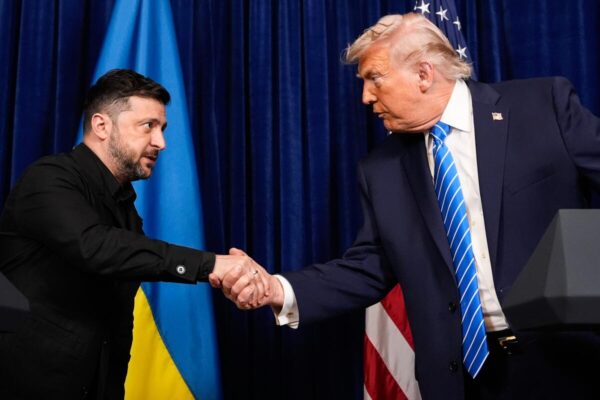
These reflections are emerging out of an interview on TVC World News with award-winning anchor Precious Amayo, post-Florida peace talks.
As guest I was meant to assess U.S. President Donald Trump’s assertion that a Ukraine–Russia peace deal is “getting very close,” following his engagement with Ukrainian President Volodymyr Zelenskyy.
The Trump statement understandably attracts global attention. After more than two years of war, devastation, and human suffering, the world is eager for good news. Yet diplomacy teaches a sobering lesson: proximity to peace talks is not the same as proximity to peace itself.
Declaring Peace Versus Constructing Peace
History is littered with moments when ceasefires were celebrated as breakthroughs, only to collapse because the foundations were weak. Peace is not a headline; it is an architecture. It must be built carefully, deliberately, and with an eye on durability.
For Ukraine, the core questions remain unchanged and unresolved: territorial sovereignty, binding security guarantees, accountability for aggression, and credible enforcement mechanisms. Any deal that sidesteps these issues may quiet the guns temporarily, but it will not silence the conflict. At best, it freezes the war. At worst, it postpones a more dangerous resumption.
Zelenskyy’s Political Reality
President Zelenskyy does not negotiate in a vacuum. He negotiates with history watching and a nation bearing deep scars. No Ukrainian leader can credibly accept an agreement that compromises sovereignty, legitimises territorial conquest, or leaves Ukraine exposed to renewed aggression. Peace, to be legitimate, must be defensible not only internationally but domestically.
This is why vague assurances or loosely worded guarantees will not suffice. Ukrainians are not merely seeking an end to fighting; they are seeking assurance that this war truly ends, not that it pauses.
The Limits of Transactional Diplomacy
President Trump’s approach to diplomacy has often been described as transactional: deal-driven, personality-centric, and impatient with process. Such an approach can, in certain contexts, unlock stalled conversations. But wars rooted in territory, identity, and power rarely yield to transactional shortcuts.
Durable peace requires institutions, allies, and shared ownership. It must survive the mediator. Agreements built primarily on personal brokerage, without multilateral anchoring, tend to unravel once political winds change.
Europe Cannot Be a Spectator
One striking element of current peace talk narratives is how easily Europe risks being sidelined. Yet this war is unfolding on Europe’s doorstep, reshaping its security architecture, energy policy, and strategic autonomy. Europe cannot afford to outsource its future.
Any credible settlement must be co-designed with Europe as a principal stakeholder, grounded in international law, and aligned with broader Euro-Atlantic security arrangements. Peace imposed from outside, without European buy-in, without Europe being a co-architect would be neither stable nor sustainable.
Peace Worth the Name
The world should encourage diplomacy. Always! But it should resist the temptation to confuse optimism with outcome. Ceasefire is not peace. Declarations are not guarantees, neither is hope a strategy.
If current efforts culminate in a settlement that secures Ukraine’s sovereignty, guarantees its security, and deters future aggression, history will record it as a triumph of diplomacy. If not, it will stand as another cautionary tale of peace declared too early and constructed too weakly.
In international relations, as in life, peace is not the absence of conflict; it is the presence of justice, structure, and trust. Anything less is merely an intermission.