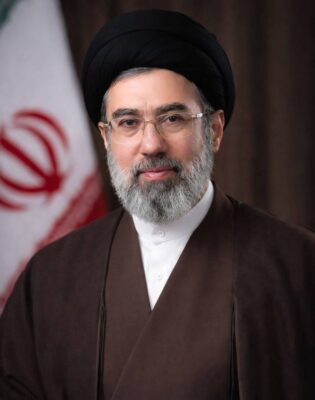
Mojtaba Khamenei, the son of the late Iranian supreme leader Ayatollah Ali Khamenei, has been named to take over the leadership of the country following the assassination of his father in the first wave of joint US-Israel attacks on the country.
The 56-year-old younger Khamenei was announced as his father’s successor on Sunday after a vote by the assembly of experts, a group of clerics responsible for the appointment of Iran’s highest authority.
The Assembly of Experts defended the appointment of the 56-year-old successor, describing it as ‘an act of defiance’ and a strong message to Americans and Israelis that it will continue to defend its system of governance.
Khamenei will now be charged with leading Iran through the biggest crisis in its 47-year history as his father’s successor.
Before the 1979 Islamic revolution, which established the position of supreme leader as the cornerstone of Iran’s theocratic system, the country was ruled by the Pahlavi dynasty.
In Iran, the supreme leader has the final say in all matters of state, above the president.
According to Al Jazeera, Key political leaders, including the powerful Islamic Revolutionary Guard Corps (IRGC) and the armed forces, were quick to pledge their backing to the new leader.
Iran’s President Masoud Pezeshkian said the appointment heralded a “new era of dignity and strength” for the nation. “This valuable choice is a manifestation of the will of the Islamic nation to consolidate national unity; a unity that, like a solid barrier, has made the Iranian nation resistant to the conspiracies of the enemies,” he said.
Foreign Minister Abbas Araghchi also congratulated the new leader. “We pledge that, in defence of the rights of the great Iranian nation, the advancement of national interests and security, and the realisation of the lofty goals of the Islamic revolution, we shall not falter for a moment,” he wrote.
Ali Larijani, secretary of the Supreme National Security Council, who has been tasked with steering Iran’s security strategy since the US and Israel launched their all-out offensive on February 28, called for unity around the new supreme leader.
The head of Iran’s powerful Expediency Council, Sadiq Larijani, also joined the chorus of political leaders expressing support for the appointment, saying it reaffirmed the need to continue in the “luminous” path of Iran’s first supreme leader, Ruhollah Khomeini.
Parliament Speaker Mohammad Bagher Ghalibaf welcomed the choice, saying that following the new supreme leader was a “religious and national duty”, while a statement from the defence council said, “We will obey the commander-in-chief until the last drop of our blood.”
Mojtaba Khamenei has never run for office or been subjected to a public vote, but has long been a highly influential figure in the inner circle of the supreme leader, cultivating deep ties to the IRGC.
Rami Khouri, a distinguished public policy fellow at the American University of Beirut, said Khamenei’s appointment signals “continuity”, adding that it remains to be seen whether the new supreme leader will push for negotiations to end the war.
Either way, he said, the appointment was “an act of defiance”. Iran is “telling the Americans and Israelis, ‘You wanted to get rid of our system? Well … this is a more radical person than his father, who was assassinated,’” he said.
What To Know About Mojtaba Khamenei
In recent years, Khamenei had increasingly been touted as a potential replacement for his father, who had been in power since 1989.
He was born on September 8, 1969. The cleric previously operated behind the scenes as a key power broker.
The younger Khamenei lived a largely secretive life, as the public has little knowledge about his political and personal life activities.
His rise to the position is viewed by many as a sign that more hardline factions in Iran’s establishment retain power, and could indicate that the government has little desire to agree to a deal or negotiations in the short term as the war enters its second week.
His appointment signals the first time in the Islamic Republic’s history that a son directly succeeds his father in this role.
Khamenei had always enjoyed high popularity among rank-and-file Islamists because he was so close to his father and assumed a leadership role of deputy chief of staff for political and security affairs in his office while the ayatollah was alive.
Khamenei has never held government office but was described as a gatekeeper to his father. He was the ayatollah’s second-oldest son.
Though state and international media often touted him as a likely successor, it was assumed that grievances, including a deteriorating economy, a repressive domestic policy, and foreign policy goals that saw many losses towards the end of his father’s regime, could work against him.
He studied under religious conservatives in seminaries in the city of Qom and is described as a hardliner with close ties to the Islamic Revolutionary Guard Corps (IRGC), where he served in the Habib Battalion during the Iran-Iraq War.
SANCTIONED BY THE US
In 2019, the US sanctioned Khamenei, alongside his father and close associates, for having “oppressed the Iranian people, exported terrorism, and advanced destabilising policies around the world” over decades.
According to the US, Khamenei worked closely with the IRGC Qods Force and also the Basij Resistance Force (Basij) to advance his father’s “destabilising regional ambitions and oppressive domestic objectives”.
The sanctions sought to block funds from flowing to a shadow network of the late ayatollah’s military and foreign affairs advisors.