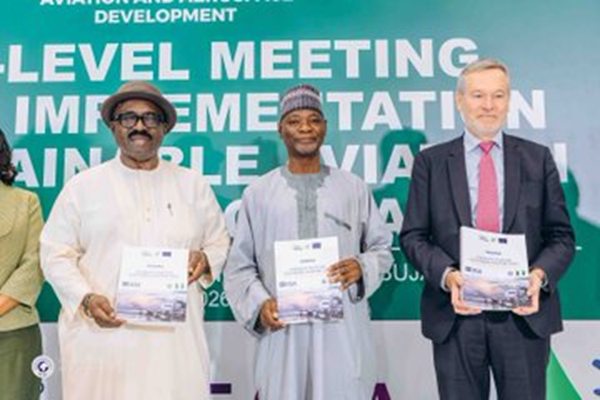
Nigeria has launched its Sustainable Aviation Fuel (SAF) programme as part of efforts to reduce carbon emissions in the aviation sector and position the country as a leader in Africa’s green aviation transition.
The initiative was unveiled on Monday, July 20, 2026, at the International Conference Centre, Abuja, during a high-level event organised by the Nigeria Civil Aviation Authority (NCAA) in partnership with the International Civil Aviation Organization (ICAO), the European Union (EU), and the European Union Aviation Safety Agency (EASA).
The event featured the inauguration of a seven-member National High-Level SAF Steering Committee, the presentation of Nigeria’s SAF Feasibility Study, and the launch of the ICAO-supported SAF Business Implementation Study.
This was disclosed in a statement via the X handle of the NCAA on Monday, July 20.
READ ALSO: NCAA Fines Saudi Airlines N6m Over Consumer Protection Violations
Inaugurating the committee, the Minister of Aviation and Aerospace Development, Festus Keyamo (SAN), said the body would serve as a national platform responsible for providing strategic direction, coordinating implementation efforts and ensuring the successful delivery of Nigeria’s SAF Implementation Programme.
ADVERTISEMENT
Keyamo, who was represented by the Director of Air Transport Management in the ministry, Mohammed Ahmed Tijani, described the programme as a major milestone in Nigeria’s drive to develop a sustainable and competitive aviation industry.
According to him, sustainable aviation fuel offers Nigeria an opportunity to reduce carbon emissions while creating economic opportunities across key sectors.
“SAF presents Nigeria with a strategic opportunity to cut carbon emissions while attracting investment, creating jobs, strengthening energy security and unlocking value across the nation’s agriculture, energy and industrial sectors,” the minister said.
He urged members of the steering committee to execute their responsibilities with commitment, innovation and a strong sense of national purpose.
Speaking at the event, the Director-General of the NCAA, Capt. Chris Najomo, described the programme as a turning point in Nigeria’s aviation sustainability efforts, saying the country had moved beyond planning into implementation.
ADVERTISEMENT
Najomo said the feasibility study, developed under the ICAO Assistance, Capacity-building and Training for Sustainable Aviation Fuels (ACT-SAF) Programme, with funding from the European Union and technical support from EASA, provides a foundation for transforming Nigeria’s available feedstock resources into commercially viable SAF production.
“This occasion is a defining moment in Nigeria’s aviation sustainability journey,” Najomo said, adding that the country was transitioning “from planning to implementation.”
The NCAA boss reaffirmed the agency’s commitment to coordinating stakeholders and driving the programme as the secretariat of the National High-Level Sustainable Aviation Fuel Steering Committee.
He also appreciated Nigeria’s international partners, particularly the European Union, EASA and ICAO, for their support in advancing the country’s sustainable aviation goals.