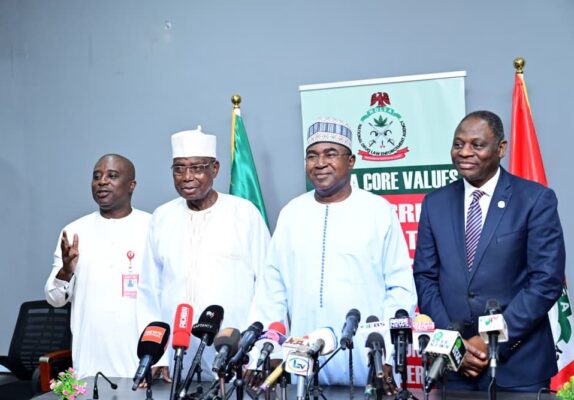
The Chairman and Chief Executive Officer of the National Drug Law Enforcement Agency (NDLEA), Brigadier General Mohamed Buba Marwa (retd), has called for a strong national response and sustained support for Nigeria’s alternative development programme aimed at curbing illicit cannabis cultivation, uplifting rural communities and strengthening national security.
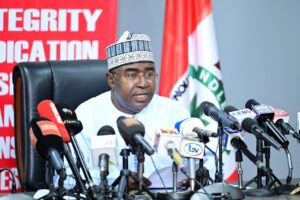
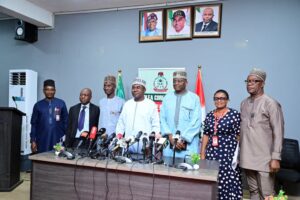
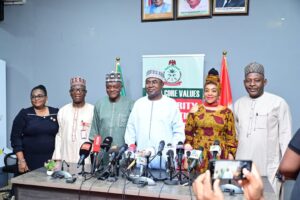
Marwa made the call at a press conference in Abuja on Tuesday, following the launch of Africa’s first alternative development drug-control pilot scheme in three cannabis-producing communities in Ondo State.
The pilot programme, introduced last week in Ilu Abo, Ifon and Eleyewo communities, is designed to replace illicit cannabis cultivation with sustainable agricultural and economic opportunities.
Explaining the strategy, Marwa said alternative development goes beyond simple crop substitution, noting that it offers wider social and economic benefits.
“These include strengthening rural economies through value-chain development; reducing pressure on law enforcement and the justice system; promoting peace and social cohesion in previously crime-prone areas; supporting national food production and agricultural diversification; and improving Nigeria’s international standing in global drug control and development cooperation,” he said.
According to him, the successful take-off of the Ondo pilot scheme has shown that the approach works when communities are fully engaged and empowered.
“We therefore call for a strong national response and sustained support from all stakeholders across all levels of government, traditional rulers and community leaders, development partners and donor agencies, the private sector, civil society organisations and the media,” Marwa said.
He urged communities affected by illicit drug cultivation to embrace the programme and work with the NDLEA to build lawful and productive livelihoods, stressing that the initiative is a people-centred development intervention.
“The alternative development programme is not just a drug control initiative; it is designed to uplift communities, strengthen national security and secure Nigeria’s future,” he said.
Marwa assured that the NDLEA remains committed to expanding the programme nationwide in line with the Renewed Hope Agenda of the President Bola Ahmed Tinubu administration.
Speaking on the Ondo pilot scheme, he said one of its most encouraging outcomes was the strong acceptance by host communities and their traditional leaders, who described the initiative as restoring their confidence in government.
“They recognise that alternative development provides dignified and lawful income for farmers, reduces poverty and vulnerability in rural households, improves food security and enhances community stability and safety,” he said.
Marwa noted that illicit cannabis cultivation fuels organised crime and insecurity, adding that replacing it with sustainable livelihoods addresses the root causes of drug production rather than its symptoms.
He said the scale of cannabis cultivation and use in Nigeria compelled the NDLEA to look beyond enforcement alone and adopt a United Nations-endorsed development approach.
Citing the 2018 National Drug Use Survey by the National Bureau of Statistics, with support from the United Nations Office on Drugs and Crime (UNODC), Marwa said about 14.4 per cent of Nigerians aged 15 to 64 — an estimated 14.3 million people — reported using at least one psychoactive substance in the past year, more than twice the global average.
He added that cannabis remains the most widely used and cultivated illicit drug in Nigeria, with an estimated 10.6 million adults reporting its use annually.
Field assessments in high-risk areas of the South West, he said, revealed that nearly 8,900 hectares of land are under cannabis cultivation, often hidden in forests and remote locations and linked to organised criminal networks.
Marwa also disclosed that over 75 per cent of the 15 million kilogrammes of illicit drugs seized by the NDLEA in the past five years were cannabis.
“Just imagine the harm that quantity would have done to our youths, public health and national security,” he said.
He expressed confidence that the alternative development initiative would reverse the trend if it receives sustained national backing.
Marwa commended national stakeholders and international partners for their support, including the UNODC, the International Institute of Tropical Agriculture (IITA), the Global Partnership on Drug Policies and Development (GPDPD), the Mae Fah Luang Foundation, as well as several countries and development partners.
He also acknowledged the support of the Ondo State Government and the Federal Ministry of Agriculture and Food Security.