By: Collins Nweke
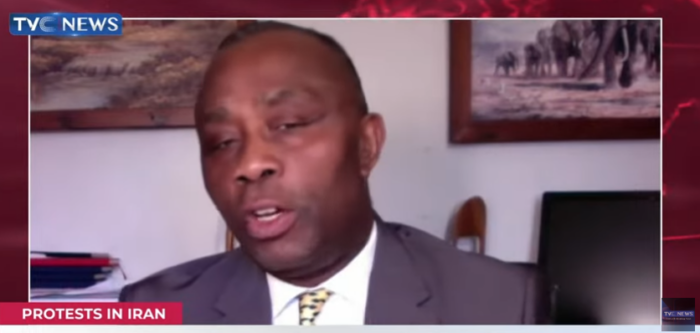
Inspired by a live interview on The World Now at Television Continental, this opinion editorial looks at the inevitability of Africa learning from Iran that economic pain without political inclusion is not a sustainable formula. As Africa’s economic powerhouse, the challenge for Nigeria is not just to grow the economy. It is to ensure every Nigerian can feel that growth in their household.
For days, dramatic protests have been sweeping Iran. The trigger is deepening economic hardship. The protests are a stark reminder that economic distress does not stay in the economic box. It quickly becomes political, social, and ultimately destabilising. While Iran’s context is distinct, African nations, and Nigeria in particular, would be unwise to view recent events as a problem far from the beds of the Abuja elites because they are “happening over there.”
They are happening in every market stall, at every unemployed youth’s doorstep, at every threat real or imagined felt by tax reform, and in every government budget debate across the continent.
Economic Pain Is Political Pain
In Iran, protests began with traders in the Grand Bazaar. It did not begin with opposition parties or activists. The same dynamic plays out across Africa, where informal economies form the backbone of daily life.
In Nigeria, inflation, though gradually easing, remains a pressing issue. The Central Bank forecasts inflation averaging nearly 13 % in 2026, following a year when prices dipped from multi-decade highs to about 14.45 % in late 2025 after sustained reforms. While this represents progress, prices are still painfully high for many households.
Compounding the picture, Nigeria’s real GDP growth hovered near 4 % in 2025, driven by both non-oil activity and stronger oil output. Yet crucially, economic growth is not yet translating into broad improvements in living standards, with poverty and inequality remaining entrenched. According to the World Bank, around 60 % of Nigerians, roughly 129 million people, still live below the national poverty line.
These figures matter because they illuminate a critical truth: aggregate growth doesn’t automatically reduce hardship. This is more so when food, transport, housing, and energy costs outpace wage and income gains.
Nigeria’s Informal Sector: The Canary in the Mine
Nigeria’s informal economy, including market traders, bus conductors, mobile shoemakers, and Bolé rooster, employs a large majority of working citizens. When inflation and exchange-rate volatility raise the cost of staples and inputs, the informal sector feels it first.
One evocative Nigerian measure of inflation is the “Jollof Index,” which tracks the cost of ingredients used to prepare a common pot of Jollof rice, a cultural staple. As of mid-2025, the average cost of preparing a single pot had soared by over 150 % compared to 2023, consuming a large share of low-income budgets. This is economic pain that is immediately lived. It is not abstract, not distant. Such lived experiences are precisely the catalysts of social unrest.
Reform Without Trust Is Fragile
Nigeria’s bold reform; including subsidy removal, exchange-rate unification, and tax restructuring; reflect a commendable effort to stabilise and modernise the economy. The government’s 2026 budget projects a deficit of about 4.3 % of GDP while targeting continued growth and currency stability. Yet reform that sharpens prices without visible social buffers can leave large segments of the population feeling like they are paying the price for policies that benefit only elites. In 2024, Nigeria witnessed significant labour action demanding better wages and protection against cost-of-living pressures.
Read Also
This reinforces a broader lesson: economic reform requires social protection. Removing subsidies and floating currencies may be technically sound. But without social safety nets and credible public engagement, reform risks breeding discontent.
Institutions Matter but Trust Matters More
Iran’s leadership has attempted to frame protests as external interference. That may very well be the case. But across societies, citizens trust lived experience more than political rhetoric. In Nigeria, public frustration over rising prices, unemployment, and insecurity has repeatedly manifested in industrial actions and public demonstrations.
The International Monetary Fund notes that Nigeria’s GDP per capita recently declined. This is an important signal that average incomes aren’t keeping pace with population growth. Moreover, governance and accountability deficits can intensify economic frustration into political fissures. Africans can learn from Iran that stability enforced by force or denial is brittle. Stability built on trust and inclusive growth endures.
Demography and Destiny
Both Iran and Nigeria have youthful populations. Nigeria’s youth bulge, which is a potential demographic dividend, can rapidly turn into a political accelerant if job creation and economic inclusion lag behind expectations.
Here again, Nigeria must act with urgency: job-creating reforms, investment in skills and infrastructure, and policies that bridge not just economic reform but opportunity creation.
A Pan-African Clarion Call
The Iranian crisis is not a distant story. It is a warning that echoes across African capitals:
- Economic hardship becomes political upheaval when expectations outstrip delivery.
- Informal economies are early warning systems. Ignoring them is dangerous.
- Reform without cushioning the vulnerable fuels unrest rather than resilience.
- Democracy and social contract legitimacy are as vital as macroeconomic stability.
For Nigeria and Africa at large, the choice is clear but demanding: advance inclusive, people-centred reforms that deliver not just stability on paper, but dignity in daily life. Because when even “Agege Bread” becomes unaffordable while Tejiosho and Balogun markets are empty, discontent will find a voice, no matter where you govern.
“Africa must learn from Iran that economic pain without political inclusion is not a sustainable formula. Nigeria’s challenge is not just to grow the economy — it is to ensure every Nigerian can feel that growth in their household.”