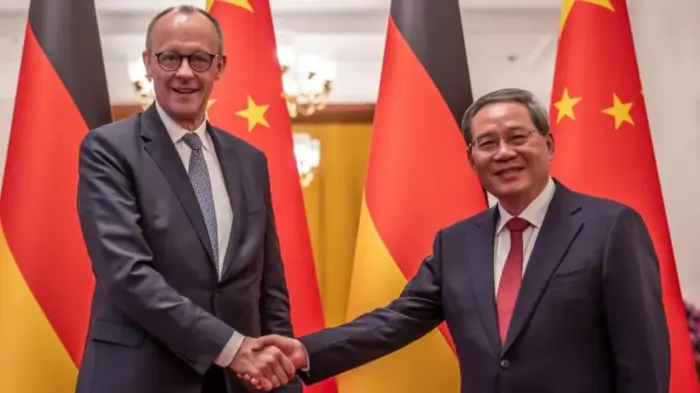
Friedrich Merz has arrived in Beijing for high-level talks with Chinese leaders, as Germany confronts a widening trade imbalance with its largest trading partner.
Before departing, Merz said Berlin was seeking “a partnership with China that is balanced, reliable, regulated and fair.”
Official data shows that imports into Germany from China were more than double the value of German exports to China last year. In 2025, goods worth €170.6 billion entered Germany from China — an 8.8% increase year-on-year — while German exports to China fell by 9.7% to €81.3 billion.
China reclaimed its position as Germany’s top trading partner in 2025, overtaking the United States. However, behind that headline figure lies a growing concern for Europe’s largest economy.
According to Jürgen Matthes, head of International Economic Policy at the German Economic Institute (IW), the imbalance is “eroding the core of German industry,” particularly in the automotive, machinery and chemicals sectors. He attributes the disparity largely to substantial Chinese subsidies and what he describes as currency undervaluation.
Chinese authorities have consistently maintained that their subsidy policies are transparent and aligned with international trade rules. In response to previous claims of currency manipulation, Beijing has stated that it operates a market-based floating exchange rate system, managed where necessary.
The swelling trade deficit — affecting not only Germany but the wider European Union — has been labelled the latest “China shock.” Analysts at the Brussels-based think tank Bruegel suggest the trend was accelerated by the Covid-19 pandemic and Russia’s full-scale invasion of Ukraine, both of which drove up production costs in Europe. At the same time, China entered a prolonged period of deflation linked to heavy investment in manufacturing, resulting in significant industrial overcapacity.
European policymakers now face mounting pressure to shield domestic industries from a surge of low-cost Chinese imports. The situation is further complicated by global trade tensions, including tariff measures introduced by US President Donald Trump.
“No one in Europe wants a two-front trade war with the world’s two superpowers,” said Noah Barkin, a visiting senior fellow at the German Marshall Fund. However, he noted that China’s overcapacity gives Europe some leverage, as Beijing requires external markets for its goods.
In Germany, the strain is particularly acute. The country’s once-dominant automotive industry is grappling with job losses amid a challenging transition to electric vehicles — a sector in which China has established global leadership.
Business associations have urged Merz to use his inaugural visit to China to address market distortions and export controls on critical raw materials, including rare earth elements. Industry leaders are also calling for stronger measures to ensure fair competition where necessary.
Within the European Union, debate continues over how best to respond. While France has advocated a more protective trade posture, Germany has traditionally favoured open markets. The European Commission has launched several anti-dumping investigations into Chinese imports and is considering policies to strengthen domestic production and reduce foreign dependencies.
For Berlin, the moment represents a reassessment of its long-standing strategy of “change through trade” — a policy closely associated with former Chancellor Angela Merkel, who was often criticised for prioritising economic ties with Beijing despite human rights concerns.
Speaking ahead of his departure, Merz reaffirmed Germany’s commitment to “de-risking” its economic relationship with China but cautioned against full decoupling.
“It would be a mistake for us to seek to decouple ourselves from China,” he said.
During his visit, Merz is also expected to urge Beijing to use its influence with Moscow to help bring an end to the war in Ukraine, adding a geopolitical dimension to talks already overshadowed by deep economic tensions.