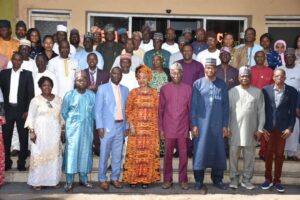
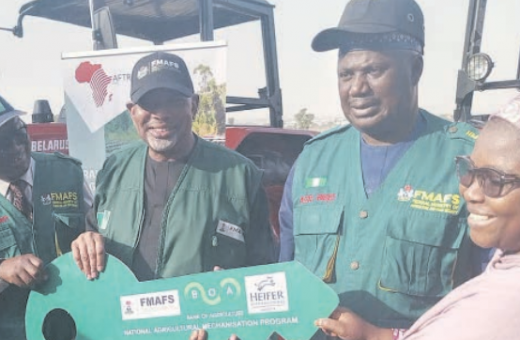
The Federal Government has launched an ambitious mechanisation programme that will see the deployment of 2,000 tractors and over 9,000 precision implements nationwide, in what officials describe as a bold push to transform food production and strengthen national food security.
Minister of Agriculture and Food Security, Abubakar Kyari, who unveiled the initiative in Abuja, said the rollout would begin with 600 tractors, followed by additional phases of 750 and 650 units respectively.
He described the Renewed Hope National Agricultural Mechanisation initiative as the largest of its kind ever undertaken on the African continent.
“This is not merely an equipment rollout, it is the ignition of a National Agricultural Productivity Revolution, ending the long era of low factor density in Nigeria.
“This will culminate in the nationwide deployment of 2,000 mechanisation assets,” he said, noting that more than 10,000 applications had already been received for the first phase.
Kyari clarified that the tractors would not be handed out to individuals but allocated to certified mechanisation service providers to ensure optimal usage and broad access.
READ ALSO: Agric Minister Abubakar Kyari Emerges IFAD Governing Council Chairman
“These tractors are not distributed for private ownership. They are entrusted to mechanisation service providers where each tractor, with the capacity to service approximately 600 hectares per year, becomes a multiplier of productivity.”
According to the minister, the programme is designed to support over 1.2 million farmers and cover more than 1.5 million hectares annually, addressing Nigeria’s long-standing mechanisation deficit.
“This is not just about 2,000 beneficiaries. It is about national food sovereignty. Mechanisation provides the power, finance provides the liquidity, and policy provides the stability. Together, they deliver food security, job creation, and economic resilience,” he said.
Read Also
Each tractor will come with two years of free service support, while mobile workshops and mechanisation centres will be established nationwide to guarantee maintenance and sustainability.
“We are not importing dependency. We are building industrial capability,” Kyari added, disclosing plans to establish seven mega mechanisation centres and a domestic tractor assembly plant with capacity to produce between 2,000 and 4,000 units annually.
The programme is supported by a N50 billion agricultural finance facility backed by the World Bank, Heifer International and other technical partners, aimed at empowering smallholder farmers and boosting agro-industrial capacity.
Minister of State for Agriculture and Food Security, Aliyu Abdullahi, said Nigeria’s mechanisation density of 0.27 horsepower per hectare remains far below global and African averages.
“If you have 10,000 hectares of rice and rely on manual labour, it will take so long, but with mechanised equipment, it can be completed within days. Mechanisation will significantly improve productivity,” Abdullahi said.
He explained that the initiative would operate through mechanisation service centres, enabling farmers to access equipment without bearing the cost of ownership.
“If you have half a hectare or one hectare, it does not make economic sense to acquire a tractor. But access to mechanisation service centres ensures efficiency and productivity,” he said.
Abdullahi assured that implementation would be inclusive, particularly for women who account for a substantial share of agricultural output.
“Women contribute about 70 per cent of agricultural production processes. We will continue to partner with them as we deepen mechanisation,” he added.