Nigeria has reiterated its firm commitment to prioritising women, children and vulnerable populations in national and global development efforts at the Arab Ministerial Conference on the Implementation of the Doha Declaration 2025, held in Amman, Jordan.
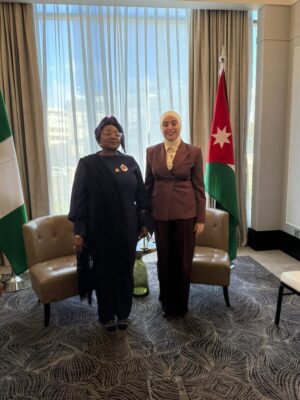
The Honourable Minister of Women Affairs and Social Development, Imaan Sulaiman-Ibrahim, who represented Nigeria at the high-level forum, engaged with Arab ministers, heads of delegations, and leaders of international and regional organisations on shared priorities in social development and inclusive growth.
Speaking on behalf of President Bola Ahmed Tinubu, the Minister conveyed Nigeria’s goodwill to the Government and people of the Hashemite Kingdom of Jordan, commending the host country for convening what she described as a timely and strategic platform to advance collective action on inclusive development. She stressed that social development is a fundamental human right and a critical pillar for peace, stability and sustainable prosperity.
In a statement issued on Wednesday by her Special Adviser on Media and Publicity, Mr Jonathan Eze, Sulaiman-Ibrahim affirmed Nigeria’s strong alignment with the objectives of the Doha Political Declaration 2025 and the outcomes of the Second World Summit for Social Development. She explained that Nigeria’s ongoing reforms are anchored on the Nigeria Agenda 2050 and the Renewed Hope Agenda, both of which place people-centred governance, poverty reduction, human capital development and inclusive growth at the core of national policy.
The Minister highlighted key institutional reforms, including the creation of Regional Development Ministries and Agencies across the six geopolitical zones, as well as Ward Development Initiatives designed to deepen grassroots inclusion and ensure balanced territorial development. She also noted that the institutionalisation of National Social Investment Programmes through a dedicated agency has strengthened the delivery of conditional cash transfers, youth employment schemes, school feeding initiatives and enterprise support, supported by an expanded National Social Register.
She further underscored the role of technology in governance, pointing to Nigeria’s upgraded National Digital Identity Portal launched in 2025, which has improved access to public services, enhanced transparency and enabled more targeted social protection. She expressed Nigeria’s readiness to strengthen cooperation with Jordan and the League of Arab States in sharing best practices on digital inclusion and efficient service delivery.
According to the Minister, youth empowerment and innovation remain central to Nigeria’s development agenda. Programmes such as the Nigeria Youth Investment Fund and the Creative Economy Development Fund are equipping young people—especially women—with skills, financing and opportunities to drive entrepreneurship and economic transformation. These initiatives are complemented by increased investments in technical and vocational education, STEM programmes and a life-cycle approach to social development.
Sulaiman-Ibrahim also showcased flagship initiatives of the Federal Ministry of Women Affairs and Social Development, including the Renewed Hope Social Impact Intervention 774, aimed at empowering over 10 million women within five years, strengthening family systems and institutionalising care through social workforce reforms. She described the Nigeria for Women Programme Scale-Up, targeting 4.5 million women nationwide, as a transformative platform for building women-led collectives that promote economic empowerment, leadership, social inclusion and community resilience.
Beyond domestic reforms, the Minister reaffirmed Nigeria’s growing investments in primary healthcare, maternal and child health, early childhood education, climate resilience, environmental sustainability, access to clean energy, and strengthened social protection and data governance systems. She emphasised that the success of the Doha Declaration hinges on sustained regional and international cooperation to address shared challenges, including climate change, economic volatility and demographic pressures.
She noted that Nigeria’s enhanced engagement with foreign governments and international development partners has led to deeper collaboration on women’s empowerment, protection of the girl child and support for vulnerable groups, further reinforcing the country’s position as a credible partner in global social development.
In closing, Sulaiman-Ibrahim reaffirmed Nigeria’s unwavering commitment to the goals of the Doha Declaration 2025 and to strengthening relations with Jordan and Arab League partners, urging delegates to measure success by tangible outcomes—improved lives, empowered women, protected children and uplifted communities.