The Federal Government has raised fresh alarm over what it describes as widespread sabotage of critical infrastructure, with the Lagos–Calabar Coastal Highway emerging as a major flashpoint.
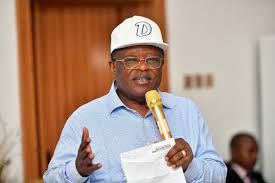
Minister of Works, David Umahi, told journalists in Abuja on Thursday that vandalism, illegal activities and indiscriminate waste disposal are undermining federal investments in roads and bridges across the country.
Describing the situation as “alarming and unsustainable,” Umahi said the ministry is locked in a “daily fight” to prevent the destruction of public assets.
According to the minister, protective installations along sections of the Lagos–Calabar Coastal Highway have been repeatedly cut and stolen, despite heightened security presence.
“The fence we have done to protect the coastal roads is being destroyed by people,” Umahi said.
”The green barbed wire we put to expose the beauty of the coastal roads in a number of sections is being cut and taken by people.”
READ ALSO: Drama as Ebonyi, Kano Senators Clash During Umahi’s Budget Presentation
He added that vital construction components, including connecting rods known as dowel bars, have also been removed by vandals, disrupting ongoing works.
Citing a stretch in Shagamu, Umahi explained that the road measures 12 metres in width, with nine metres already paved and three metres pending completion. However, unauthorised access to restricted construction zones has compounded the damage.
“The width of our road is 12 metres, and nine metres have been completed. There are connecting wire bars and protective coverings. Yet people go there, cross into the restricted areas and damage the work,” he said.
The Lagos–Calabar Coastal Highway, designed to span about 700 kilometres from Lagos to Calabar in Cross River State is one of the Federal Government’s flagship projects aimed at enhancing trade, tourism and regional connectivity. Its first phase in Lagos has, however, faced disputes over right-of-way and environmental concerns.
Umahi linked recent flooding along the corridor to refuse dumped into underground drainage systems.
“The flooding of the coastal highway was because our underground drainage channels were blocked. People dump refuse inside the manholes and underground channels. When those channels are blocked, water has nowhere to go. That is the basic reason for flooding seen on the coastal road, and I think for most places in Lagos.
“The public has a duty to protect public assets. We are doing everything possible to ensure the coastal highway is free and functional, but citizens must also play their part,” he said.
He disclosed that he personally inspected affected areas in Lagos two weeks ago and commended the state government and police for deploying operatives to curb vandalism.
“I thank the governor and the people of Lagos State, as well as the Commissioner of Police.
“There has been a massive deployment within the coastal route to check vandalism. But as we speak now, the things we have done to protect the coastal route are being destroyed by people,” he said.
“This press briefing is to bring to the attention of the public the massive vandalism of our critical infrastructure all over the country. Within the coastal route that is being circulated, you can see massive break-ins. It is a daily fight,” he added.
Beyond the coastal project, the minister raised concerns about the condition of major Lagos bridges, including the Carter Bridge and the Third Mainland Bridge.
He revealed that investigations and expert consultations had identified serious structural issues with Carter Bridge, with recommendations pointing towards eventual demolition.
Read Also
“To the extent that by investigations and stakeholders’ meetings, experts have said Carter Bridge has to be demolished.
“But we are doing everything possible to strengthen it so that we can use it for the next three years pending reconstruction,” he said.
Umahi attributed much of the deterioration to illegal sand mining around bridge foundations, explaining that many bridge piles rely on surrounding sand for stability. In one instance, he said, a miner struck and removed a bridge pile.
“We have directed that the company involved be prosecuted. These illegalities have serious consequences on our infrastructure,” he said.
He also cited the theft of expansion joints on bridges, reinforced concrete barriers along the Abuja–Kaduna–Zaria–Kano highway, and electrical fittings on flyovers nationwide.
“Just about two weeks back, we caught people removing expansion joints on Carter Bridge in Lagos.
“This is the second time we are catching people there,” he said, noting that such components are often sold as scrap, weakening bridge integrity.
The minister credited the installation of Closed-Circuit Television cameras on the Third Mainland Bridge—implemented on the directive of Bola Tinubu—with aiding law enforcement.
“It was very easy for the police to catch the vandals because of the CCTV installed there,” he said.
Umahi also warned against parking heavy-duty trucks on bridges, stressing that such structures are not designed for prolonged static loads.
“Roads and bridges are never designed for static loads. When you allow heavy trucks and vehicles to be parked on bridges, you are asking for trouble,” he cautioned.
He reiterated that the government has adopted reinforced concrete technology to enhance the durability of new projects.
“The President inherited a very terrible state of roads and bridges. That is why he introduced reinforced concrete technology.
“The roads we are building now will last between 50 and 100 years, unlike many older roads that failed within 10 years,” he said.
While acknowledging that project execution cannot be flawless, Umahi maintained that the ministry remains committed to accountability.
“No one is God. No human being does anything in perfect order. But we are doing everything within the limit of our ability and conscience to ensure there is value for money and that we address the needs of our people,” he said.
He concluded with a call for collective vigilance, warning that unchecked vandalism would continue to drain public resources and stall national development.
“If we do not protect this infrastructure, repairs will have to be repeated. That is not good for our society.
“The President is working tirelessly to deliver these projects, and we must all help to protect them,” he said.