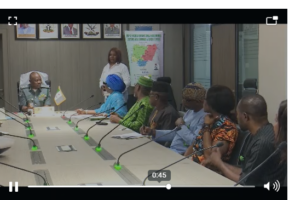

The Chairman of the Independent National Electoral Commission (INEC), Prof. Joash Amupitan, has said the credibility of elections in Nigeria begins with political parties operating transparently and within the law.
Amupitan made the remark at the weekend as political parties prepare for their primaries scheduled to hold between April 23 and May 30 ahead of the 2027 general election.
He also revealed that the electoral body is reviewing its guidelines and regulations for political parties to align with the provisions of the Electoral Act 2026 and emerging electoral realities.
The INEC chairman disclosed this in a statement issued by his Chief Press Secretary, Dayo Oketola, noting that the review became necessary following significant legal and operational changes introduced by the new electoral law.
According to the statement, the changes affect political party administration, candidate nomination processes, compliance obligations, dispute resolution mechanisms and the Commission’s regulatory responsibilities.
It added that INEC is updating its subsidiary regulations to ensure full legal alignment and operational clarity ahead of the next electoral cycle.
Amupitan explained that lessons from previous elections were also informing the review process, particularly recurring challenges such as opaque party primaries, membership disputes, weak financial disclosure practices and exclusionary participation patterns.
He said these challenges had often led to avoidable litigation and electoral uncertainty.
“To support evidence-based reforms, INEC is mainstreaming findings from the Political Party Performance Index (PPPI), a diagnostic assessment tool that identifies systemic weaknesses in party governance and compliance practices across the country,” the statement said.
The objective, according to the Commission, is to move regulatory oversight from reactive enforcement to proactive supervision based on measurable standards.
Amupitan stressed that credible elections begin long before polling day.
“For elections to inspire public confidence, the institutions that produce candidates must themselves operate transparently and within the law,” he said.
The INEC chairman also disclosed that technical support for aspects of the review process is being provided by the Westminster Foundation for Democracy (WFD), alongside Nigerian legal and electoral experts.
Speaking on electoral reforms, Country Director of WFD Nigeria, Adebowale Olorunmola, said political parties were increasingly being held to the same high standards of integrity expected of the electoral commission.
Olorunmola noted that anchoring regulatory reforms on empirical evidence, including insights from the Political Party Performance Index, would help deepen compliance, reduce avoidable electoral disputes and promote greater transparency, inclusivity and internal democracy within political parties.
Meanwhile, Amupitan has assured Nigerians that technical glitches experienced during the 2023 general election will not recur.
He made the assurance during a citizens’ town hall organised by the Civil Society Network on Election Integrity in Abuja.
The INEC chairman described electronic transmission of election results as a “non-issue,” saying the Commission has the capacity to transmit results electronically.
“I don’t see the issue of transmission as a problem; the problem is not the network but the adequacy of the networks we have,” he said.
Amupitan maintained that the technical challenges experienced in previous elections had been addressed.
“Glitch has been eliminated. It will not resurface in Nigeria,” he said, adding that the Commission now has the required capacity for electronic transmission of results.
He, however, acknowledged that logistics challenges were recorded during the recent Federal Capital Territory (FCT) area council election.
“We admit there were logistical issues in the FCT election,” he said.
According to him, result management and logistics remain two critical areas the Commission is working to strengthen in order to enhance transparency and credibility.
“Result management and logistics are two basic issues that, from our own end, we are trying to see how best we can manage them well to enhance the transparency and credibility of the system,” he said.
While reiterating INEC’s commitment to improving the electoral process, Amupitan urged Nigerians to moderate expectations, noting that achieving a completely flawless election may not be immediately possible.
“What Nigerians desire is a perfect election, and INEC will strive as much as possible to give this country the best election. However, we may not be able to achieve a 100 per cent perfect election for now,” he said.