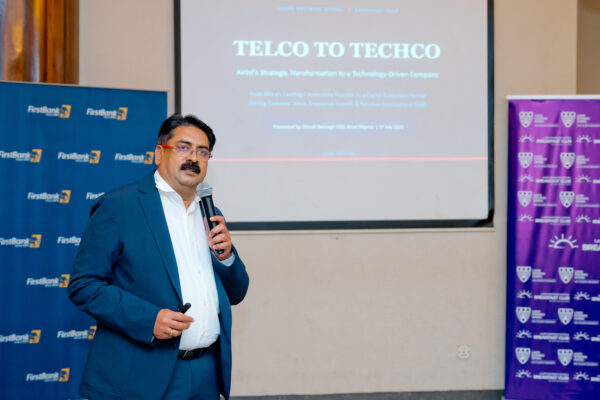
Chief Executive Officer of Airtel Nigeria, Dinesh Balsingh, has called on business leaders to accelerate Nigeria’s digital transformation by embracing intelligent technology platforms capable of driving innovation, productivity and sustainable economic growth.
He made the call on Wednesday while speaking at the Lagos Business School (LBS) Breakfast Club on the theme “From Telco to TechCo,” where industry leaders examined emerging trends shaping enterprise and the wider economy.
This was disclosed in a statement by the Director, Corporate Communications & CSR , Femi Adeniran, on Wednesday, July 1.
Balsingh said the telecommunications sector was rapidly evolving beyond traditional connectivity into a broader digital ecosystem powered by artificial intelligence (AI), Internet of Things (IoT), satellite connectivity and integrated enterprise solutions.
READ ALSO: Airtel Suspends Airtime, Data Borrowing Services
According to him, the shift reflects changing demands from businesses that now require technology capable of delivering operational efficiency and measurable outcomes.
ADVERTISEMENT
“The role of telecommunications has fundamentally changed. Businesses are no longer asking only for connectivity; they want solutions that improve productivity, strengthen security, and accelerate digital transformation. That is the journey Airtel is leading. We are evolving from a telecommunications company into a technology partner that helps organisations unlock growth and create long-term value,” he said.
Read Also
He further noted that value in the telecoms industry is no longer defined by data consumption alone, but by the tangible business results delivered through digital infrastructure.
“Technology should do more than connect people. It should protect them, simplify operations, and help businesses make better decisions. Investments are now focused on building smarter, more resilient digital infrastructure that supports organisations across every sector of the economy,” he added.
Balsingh highlighted growing adoption of AI-driven customer protection systems, industry-specific digital tools, IoT platforms, and hybrid satellite-terrestrial networks designed to extend connectivity to underserved and remote areas.
He also stressed that sectors such as healthcare, education, retail, manufacturing, government, and oil and gas are increasingly dependent on integrated digital systems combining cloud services, automation, analytics, and intelligent networking.
ADVERTISEMENT
“The organisations that will lead the next decade are those that invest today in intelligent digital infrastructure. Our customers are no longer buying connectivity alone. They are investing in productivity, intelligence, and digital transformation,” he said.
The session also featured the IMF Resident Representative for Nigeria, Christian Ebeke, as part of discussions on the future of enterprise and economic development.