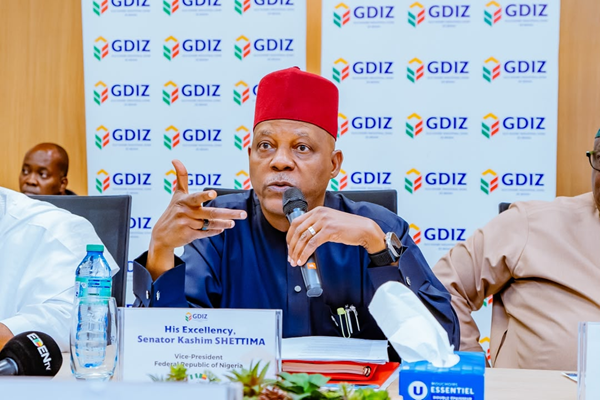
Vice President Kashim Shettima says African countries must maximise their natural resources and strengthen local production capacity to take their rightful place in global trade and resource control.
Shettima stated this on Friday, July 24, in Cotonou, Benin Republic, while leading a delegation of Nigerian governors on an official tour of the Glo-Djigbé Industrial Zone (GDIZ), according to a statement issued by his Senior Special Assistant on Media and Communications, Stanley Nkwocha.
The Vice President said Africa’s economic transformation would depend on the continent’s ability to move beyond exporting raw materials and embrace value addition through industrialisation.
He assured that the administration of President Bola Tinubu would continue to support industrial development across Nigeria, insisting that no region would be left behind in the government’s renewed industrialisation agenda.
READ ALSO: Shettima Leads Governors To Benin To Study Industrial Model For Textile Revival
“As far as Bola Ahmed Tinubu remains the President of Nigeria, no region will be left behind in the renewed industrialization drive of the Nigerian leader,” Shettima said.
ADVERTISEMENT
He added that the Federal Government, in partnership with state governments, was committed to developing industries that would create jobs and boost economic growth.
Shettima expressed satisfaction with Benin Republic’s efforts in transforming its agricultural resources into finished products for local consumption and export.
He lamented Africa’s limited share of the global textile market, noting that despite the continent’s huge cotton production potential, it benefits minimally from the industry.
“Of the $370 billion worth of global cotton, Africa benefits from only about one per cent of that amount,” he said.
The Vice President said reviving Nigeria’s textile value chain would create millions of jobs, increase non-oil exports and stimulate economic activities across the country.
ADVERTISEMENT
After inspecting the cotton, textile, cashew and soybean oil production facilities at GDIZ, Shettima said Nigeria would replicate lessons from the industrial model in its own development plans.
Read Also
“We are here essentially at the behest of His Excellency, President Bola Ahmed Tinubu, in the spirit of his Renewed Hope Agenda to see and do a peer review of global best practice and value addition,” he said.
He added: “We are setting up eight agro industrial zones in eight states in our country and to tell you imperatively that this is an African success story where there is a whole chain of value addition in cotton, cashew and soya bean value chains.”
Shettima further stated that Nigeria had gained valuable insights from the visit and would adopt relevant aspects of the Benin Republic model.
“Be rest assured that we have learnt a lot of lessons through this visit and we are going to replicate a lot of that in Nigeria, as we are focused on becoming one of the industrialized nations in the world, in line with the Renewed Hope Agenda of President Tinubu.”
ADVERTISEMENT
The delegation was briefed on the structure, production capacity and investment opportunities at GDIZ by Benin Republic’s Minister of Tourism and Foreign Trade, in charge of Industry and Promotion of Private Investment, Olushegun Adjadi Bakari.
The Nigerian delegation inspected integrated textile and agro-processing facilities where locally produced cotton is converted into yarn, fabric and finished garments, while cashew and other agricultural commodities are processed for domestic and export markets.
The 1,640-hectare industrial zone, developed by the Beninese government in partnership with ARISE Integrated Industrial Platforms, hosts textile, garment, cashew, soybean and other manufacturing operations, and provides more than 25,000 jobs.
The visit was part of Nigeria’s efforts to draw lessons from Benin Republic’s industrial model, particularly in linking agriculture with manufacturing, attracting private investment and transforming raw materials into finished products.
The governors who accompanied the Vice President were AbdulRahman AbdulRazak of Kwara State, Hope Uzodimma of Imo, Umar Namada of Jigawa, Umaru Dikko Radda of Katsina, Caleb Mutfwang of Plateau and Dauda Lawal of Zamfara.
ADVERTISEMENT
The governors expressed readiness to explore similar industrial projects in their respective states, highlighting opportunities for public-private partnerships, youth employment, technology transfer and stronger connections between farmers and manufacturers.
To promote sustainable industrial development, Shettima and the governors also planted trees within the industrial zone during the visit.