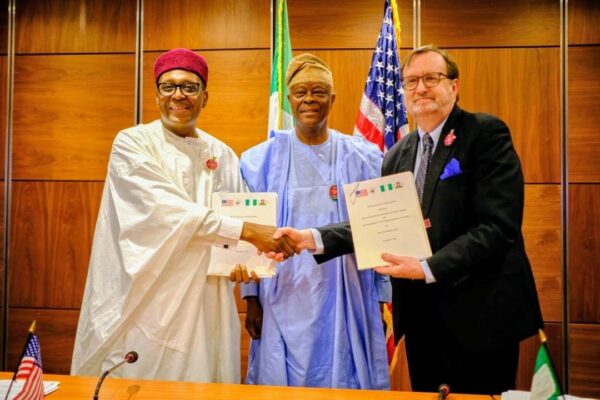
The Government of Nigeria and the Government of the United States of America have signed a landmark technical Memorandum of Understanding (MoU) to strengthen bilateral cooperation and funding for the early detection and prevention of the spread of emerging and existing infectious diseases in Nigeria, including HIV/AIDS and Tuberculosis.
The MoU also covers enhancing disease surveillance systems; strengthened safety procedures for pathogen sample collection, transport, storage, testing, and disposal; primary care, financial protection, and the provision of technical support, among other key objectives.
The MoU is aligned with Nigeria’s drive towards its own ultimate self-reliance, by reducing dependence on external aid gradually by 2030. Under this framework, Nigeria plans to progressively increase its health spending as a share of its national budget, while funding from the United States government is expected to gradually decline. This approach reflects a strategic pivot towards trade-and investment-based partnerships.
The signing of the MoU is a culmination of the efforts of the Government of Nigeria and the Government of the United States to work cooperatively towards a health system capable of preventing, detecting, and treating diseases, while expanding access to primary healthcare and attracting private sector investments necessary for long-term self-reliance.
The Federal Ministry of Health and Social Welfare had in 2023 embarked on a reform programme—the Nigeria Health Sector Renewal Investment Initiative (NHSRII)—aimed at improving healthcare accessibility, affordability, quality, accountability, and efficiency. The initiative is implemented through a Sector-Wide Approach (SWAp) that aims to align all government levels (Federal, State, Local), agencies, civil society, private sector, and development partners under a sector-wide plan, budget, and reporting framework.
In December 2023, the Health Sector Renewal Compact, signed under the leadership of President Bola Ahmed Tinubu, GCFR, brought together all 36 state governors, the Federal Capital Territory Administration, and development partners, demonstrating high-level political commitment to building a unified, efficient, and resilient health system for all Nigerians.
Under this MoU, Nigeria and the United States will further strengthen their collaboration to prevent the spread of emerging, re-emerging, and existing infectious disease threats. Over a five-year period, from April 2026 to December 2030, the United States government will provide almost $2 billion in grant funding, while Nigeria will commit at least 6% of executed annual Federal and State domestic budgets to health which is expected to mobilize nearly $3 billion for health sector development within the same timeframe. President Tinubu has already included this within the Federal Government’s proposed 2026 Appropriation.
*Areas of Cooperation*
*Surveillance and Outbreak Response*
By 2030, Nigeria envisions a national surveillance and outbreak response system led by national public health institutions with functional capabilities to detect infectious disease outbreaks with epidemic or pandemic potential within seven days of emergence; notify relevant authorities, including critical actors in the national public health system, within one day of detection; and complete initial response actions within seven days of confirmation.
The United States government plans to fund an assessment of Nigeria’s outbreak surveillance system, including disease surveillance mechanisms and safety procedures for pathogen sample collection, transport, storage, testing, and disposal. Nigeria commits to working closely with the United States to address any priority gaps identified through this assessment.
The United States plans to provide technical support, training, and guidance to strengthen national and sub-national rapid response capabilities. This includes support for Rapid Response Teams, Emergency Management and Operations Centres, Infection Prevention and Control (IPC) measures, and antimicrobial resistance detection, to ensure effective outbreak response within seven days of confirmation.
*Laboratory Systems*
Nigeria envisions a connected network of at least 12 national and specialized laboratories capable of identifying and characterizing pathogens with outbreak, epidemic, or pandemic potential; 23 regional laboratories; and over 1,500 clinical and public health laboratories at sub-national levels. These laboratories will support disease screening and diagnosis, treatment monitoring, sample collection and processing, referrals, integrated serological and molecular testing, laboratory data management, quality management systems, and standard biosafety and biosecurity practices, including laboratory waste management.
Currently, the United States government funds approximately $74 million annually in laboratory commodities procured centrally and at state and facility levels, as well as 1,198 frontline laboratory personnel, including scientists, technicians, assistants, and data clerks.
Under the MoU, the United States will fund 100% of laboratory commodities in 2026. Thereafter, U.S. funding will decline gradually, with Nigeria assuming full responsibility for funding these commodities by the end of the MoU period in 2030.
*Commodities*
Read Also
Nigeria envisions a robust, accountable, and integrated healthcare commodity supply chain system to support the achievement of Universal Health Coverage. Africa’s most populous nation plans to leverage, over time, MEDIPOOL as the primary pooled procurement mechanism, supported by two national, six zonal, and 37 state-owned warehousing facilities, alongside federal and state distribution channels for last-mile delivery. These efforts will be complemented by other Public-Private Partnership (PPP) arrangements to ensure an inclusive and efficient supply chain.
The United States government currently funds approximately $133 million annually in commodities for malaria, HIV, tuberculosis, maternal, newborn and child health (MNCH), and nutrition. Under the MoU, the United States will fund 100% of these commodities in 2026, after which funding will gradually decline, with Nigeria fully financing these commodities by 2030.
*Frontline Healthcare Workers*
Nigeria aims to progressively integrate frontline healthcare workers currently funded by the United States into its permanent health workforce by 2030. In collaboration with state governments, Nigeria also seeks to better integrate AIDS, TB, and Malaria (ATM) service delivery into the broader primary, secondary, and tertiary healthcare systems to improve efficiency, strengthen system performance, and promote holistic patient care.
The United States government will continue to fund frontline healthcare workers, including doctors, nurses, community health workers, pharmacy personnel, case managers, social workers, and other essential staff. Both governments have committed to identifying the technical and financial support required to strengthen Nigeria’s public health workforce in line with national priorities and institutional structures.
*Data Systems*
Nigeria envisions an integrated and robust health data ecosystem in line with the National Health Act (2014) and the Nigeria Digital in Health Initiative (NDHI). The Nigeria Digital Health Architecture (NDHA) defines three key exchanges: the Health Information Exchange, Health Services Exchange, and Health Insurance Claims Exchange, forming the foundation for interoperable health data.
All digital solutions across public and private healthcare sectors—including government Electronic Health Records (EHRs), tuberculosis and HIV systems funded by the United States (such as ViVA EMR, NigeriaMRS, LAMIS Plus, the National Data Repository, and the Logistics Management Information System), state-level EHRs, public health platforms like SORMAS, and private sector systems—are expected to integrate with Nigeria’s National Health Information Exchange. This interoperability will support population-level analytics, evidence-based decision-making, and improved health outcomes.
Nigeria commits to deploying NDHI-aligned digital medical record solutions in 20% of its health facilities by 2026, increasing to 40% by 2027, 60% by 2028, 80% by 2029, and 100% by 2030. The United States will support improvements in the rollout of existing EHR systems throughout the MoU period.
Both countries also intend to negotiate a regulated data-sharing arrangement to exchange information on the long-term performance of the MoU, in compliance with applicable laws governing data protection, privacy, ownership, access rights, and hosting requirements.
*Strategic Investment and Technical Assistance*
Through the NHSRII, Nigeria has identified national priority areas aligned with the Sector-Wide Approach and the Health Sector Renewal Compact, including the expansion of financial protection mechanisms and increased access to services for vulnerable populations.
The strategic goal of the MoU is to expand access to quality, affordable, and integrated health services across primary, secondary, and tertiary care levels by 2030. This will be achieved through strengthened partnerships, sustainable financing, and strategic investments in health systems, with a particular focus on improving outcomes for women and children. Private sector and civil society organizations, particularly Faith-based Organizations will play important roles and have access to dedicated funding to ensure no segment of the Nigerian population is left behind.
This initiative represents a bold and collaborative response to Nigeria’s health challenges, leveraging United States expertise and its resources, while aligning with relevant national priorities to drive a lasting, system-wide transformation of its health sector. The government of Nigeria will continue to strengthen the fiduciary systems for its health spending as well as its external partners.
The federal government of Nigeria expresses its appreciation to the government of the United States for its renewed commitment to deepening health cooperation, and reaffirms its determination to work towards achieving the objectives aligned with its own national interests. While this technical MOU focuses on health, Nigeria is committed to continuing progress in addressing other areas of mutual concern. Acknowledging also, that both the United States and Nigeria may choose to pause, extend, or opt-out of the MOU in the unanticipated event of insufficient progress.
The government also extends its gratitude to all of its development partners for their continued collaboration and support.