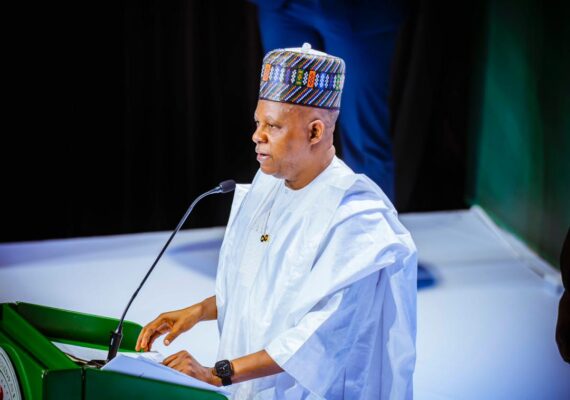
Vice President Kashim Shettima on Monday inaugurated Nigeria House at the 2026 World Economic Forum in Davos, marking the country’s debut with a sovereign pavilion at the prestigious global gathering.
He described the development as a bold demonstration of Nigeria’s renewed commitment to meaningful engagement with the international community.
Addressing participants at the commissioning ceremony, Shettima emphasised that national progress requires collaboration beyond borders.
He noted that Nigeria’s economic advancement would be driven by strategic and structured interaction with global partners.
“For the first time in our nation’s history, Nigeria stands at Davos with a sovereign pavilion of its own,” he stated.
He further explained that Nigeria House “reflects our intention, our seriousness, and above all our resolve to take a front-line seat in the discourse of the global economy, not as observers, but as participants with a clear sense of purpose.”
READ ALSO: VP Shettima Arrives In Switzerland For World Economic Forum
The Vice President highlighted that the initiative was designed as a comprehensive government platform bringing together key sectors such as trade, investment, foreign affairs, energy, infrastructure, technology, climate and culture.
However, he stressed that real economic transformation would ultimately depend on private sector involvement.
According to a statement released by Stanley Nkwocha, Senior Special Assistant to the President on Media and Communications in the Office of the Vice President, Shettima remarked that “government can open doors and de-risk environments; only enterprise can animate growth and translate policy into productivity”.
He added that the launch of Nigeria House aligns with positive outcomes from the economic reforms of President Bola Ahmed Tinubu’s administration.
The Vice President pointed to improvements in non-oil sector performance and better macroeconomic stability as evidence of progress.
Read Also
Shettima explained that sectors such as services, agriculture, finance and technology are experiencing steady expansion, while government revenue is increasingly being driven by non-oil sources.
He also noted that inflationary pressures eased through 2025, foreign reserves strengthened and confidence returned to the foreign exchange market.
Extending an invitation to global investors, the Vice President said the pavilion would serve as a hub for constructive engagement and partnership building.
“Nigeria is open for business, and more importantly, open for collaboration. Progress is not a monologue; it is a dialogue,” he declared.
Earlier in the programme, Minister of Industry, Trade and Investment, Jumoke Oduwole, commended Shettima for championing the initiative.
She described Nigeria House as the result of effective collaboration between the public and private sectors and a reflection of renewed confidence in the nation.
Oduwole revealed that investment playbooks unveiled at the event showcase opportunities in solid minerals, climate-smart agriculture, and the creative and digital industries, in line with efforts to rebuild investor trust.
Also speaking, the Permanent Secretary of the Ministry of Solid Minerals Development, Engr. Faruk Yusuf Yano, expressed optimism that Nigeria House would help attract increased non-oil investments and promote equitable access to global finance for developing economies.
The Lead Execution Partner, Omowunmi Imoukhuede, noted that the pavilion provides a unique platform for projecting Nigeria’s economic potential to the world.
The inauguration followed a Global Business Roundtable focused on resilient supply chains for the global energy transition. Among dignitaries present were the Minister of Science and Technology, Dr Kingsley Ude; the Minister of Foreign Affairs, Yusuf Tuggar; as well as heads of government agencies and leaders from the private sector.