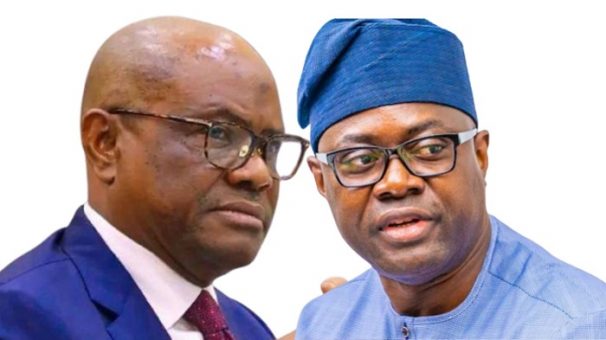
From the legal disputes surrounding the Ibadan convention to the last National Convention of the Federal Capital Territory minister Nyesom Wike-led faction, where officials of the Independent National Electoral Commission were present, the People’s Democratic Party (PDP) journey has been a back-and-forth of conflicting court orders, with the Supreme Court to have the final say. Abdul-hafeez Fadehan writes.
In what once seemed like an unbreakable bond, the Minister of the Federal Capital Territory, Nyesom Wike, and Oyo State Governor, Seyi Makinde, have transitioned from brothers-in-arms to bitter rivals. Once the dual engine of the G-5 governors, sworn allies who reshaped the landscape of the 2023 Presidential Election, the two power brokers now find themselves locked in an intense battle for the very soul and structure of the Peoples Democratic Party (PDP).
With the current power struggle, Nyesom Wike appears to have the upper hand. His position was fortified by the Federal High Court and subsequent Appellate rulings, which have consistently validated the decisions of his faction while barring INEC from recognising any rival leadership.
Consequently, the Makinde-led faction, despite its defiant Ibadan convention and a flurry of legal appeals, is now staring at a stark political reality: an Abuja convention that has the law, the electoral umpire, and the party’s primary structure firmly on its side.
The PDP crisis in 2025 raised serious questions about the party’s ability to remain a viable opposition force.
The drama began when former Jigawa Governor Sule Lamido threatened legal action over the sale of the PDP chairmanship ticket. Wike denounced Lamido’s sidelining and accused PDP governors of sabotage, including the suspension of key party figures, as well as a move by party factions to suspend others.
The current PDP’s crisis mirrors the situation preceding the 2023 election, where disgruntled members alleged a lack of consensus and fair play, leading to massive defections, with departing members citing a lack of confidence in the party structure.
Ibadan Convention
A Federal High Court in Abuja restrained INEC from recognising the outcome of the 2025 National Convention of the Makinde-led faction of the PDP held in Ibadan.
Justice James Omotosho, delivering judgment in a suit challenging the legality of the convention, predicated his decision on the PDP’s failure to comply with relevant conditions and laws for the conduct of such conventions.
The judge held that evidence from the electoral umpire and some of the respondents showed that congresses were not held in some states of the federation in breach of the law.
Wike on Ibadan National Convention
Ahead of the convention, Wike said the leadership failed to complete necessary congresses and other processes, which he said were stalling progress.
“If they do the right thing, will anybody stall the convention? They have not done the congresses and other things that should be in place,” he said.
“When we are governors, why was it that no governor left? You see that we didn’t have problems? We fought for the chairman of the party. We’ve gone to the Supreme Court. You know that, why is it that people didn’t leave?”
The PDP has faced internal crises and defections in recent months, including top members such as Peter Mbah of Enugu, Sheriff Oborevwori of Delta, and Umo Enoh of Akwa Ibom, while also contending with multiple legal battles ahead of the convention held in Ibadan.
Was Turaki Ever a PDP Chairman?
Narratives, questions and discussions have always been tagged “Turaki-led faction of the PDP National Working Committee(NWC) “, a political tag which originated from the Ibadan-convention where Kabiru Tanimu Turaki emerged as the Chairman of the NWC.
Despite Makinde’s loyalists securing a favourable ruling from an Oyo State High Court to uphold their Ibadan convention, that victory was short-lived as the Abuja Court of Appeal, a court of superior jurisdiction, dismantled the move.
A few weeks after the convention, INEC, in a letter dated December 22, 2025, and signed by its Secretary, Dr Rose Oriaran-Anthony, cited by TVC News, rejected the outcome of the Ibadan convention, which elected Turaki as Chairman of the NWC.
INEC also cited several court judgments and unresolved legal processes, which the Makinde loyalists disregarded to organise the Ibadan convention.
INEC expressed that it received several requests from legal representatives and stakeholders of the PDP to recognise and update its website with the list of national officers elected at the party’s National Convention held on November 15 and 16, 2025, in Ibadan, Oyo State.
The convention, which drew delegates from all 36 states and the FCT, was marked by sharp disagreements over zoning, accreditation delays, and allegations of last-minute manoeuvres by rival blocs.
According to the commission, the requests were reviewed “in the light of all material facts, extant laws, and subsisting court judgments touching directly on the subject matter.”
While responding to the request, INEC cited two judgments of the Federal High Court in Abuja — Suit No. FHC/ABJ/CS/2120/2025, delivered on October 31, 2025, and Suit No. FHC/ABJ/CS/2299/2025, delivered on November 14, 2025.
INEC stated that the judgments “expressly restrained” it from supervising, monitoring, recognising or affecting the outcome of the PDP National Convention held on November 15–16, 2025, or any similar exercise, pending full compliance with court orders.
In effect, INEC cannot recognise the outcome of any convention it did not supervise, as required by the Electoral Act.
2027 Factor
Makinde alleged sabotage by Wike in order to weaken the PDP’s structure and popularity ahead of the 2027 election, effectively clearing the opposition bloc for President Bola Tinubu’s re-election.
Makinde admitted he was instrumental in the 2023 election that led to the victory of President Tinubu, citing his involvement in the G5 group.
Makinde said, “Let me confess: I came into government in 2019, and towards 2023, I was yoked with them. But now, I have repented; I am no longer with them. But for them to hold the PDP for another party to be in power, it is no, no, no.”
Vowing to reclaim the party’s soul, the Governor said he is committed to challenging the Wike-led bloc via a rigorous Nigerian judicial process.
He said, “I know that a lot of you are concerned about the PDP, asking what is happening in the party. Well, we are all in Ibadan, which is the political, administrative and cultural capital of the Yoruba race. So, all these court cases will come together at some point, and the judiciary, being the last hope of the common man, will give justice to the PDP.”
Amid Makinde’s threat, Wike declared his interest in the Oyo State political structure, after a meeting of the Rahaman Mohammed-led caretaker committee, held in Abuja, which announced March 29 as the date for the party’s convention.
He said, “Let me declare my interest clearly: I am interested in the survival and success of this party. I am also interested in all the happenings in Oyo State PDP.”
Wike’s provocative declarations have ignited a wave of public sentiment, with critics alleging that his faction has transformed the PDP into a political machinery designed to ensure an APC victory in 2027.
This perceived betrayal has left the party’s grassroots in a state of disillusionment, viewing the current Abuja convention not as a revival of the PDP but as the final move in a game where the opposition’s survival has been traded for the incumbency’s gain.
Read Also
Wike’s activities, often labelled as anti-party due to his allegiance to the re-election of President Bola Ahmed Tinubu, were echoed by former Governor of Ekiti State, Ayodele Fayose, who said the individuals in the party can decide who to work with, regardless of their membership of the party.
Fayose stated this during the INEC-Court-backed PDP convention held in Abuja on March 29th and 30th, 2026.
Fayose said, “Supporting Tinubu as a PDP member is not anti-party. We must not say it’s our party member who must win when we know our party member has no capacity.”
“Would you compare a Makinde to an Asiwaju? How will you defeat an Asiwaju with 32 governors? All the fish jumped out of the water, so was it Wike that took them out of the water? All the governors in PDP jumped out of the water; tell me how they want to win with 2 governors,” he questioned.
Prior to the March 29 convention, Wike strategically rallied a formidable front of disgruntled politicians who had been sidelined ahead of the Ibadan assembly, consolidating their grievances over the party’s structure into a formidable alliance designed to dominate the PDP’s trajectory beyond the 2027 election.
However, these efforts have been undermined by defections of key political figures to other parties, while some key figures have stayed to build, but the majority of the governors who won under the party have left.
Key figures who decamped include Governor Ademola Adeleke of Osun State, Governor Ahmadu Fintiri of Adamawa State, Rivers State Governor, Sir Siminalayi Fubara and other key lawmakers who struggle for political survival.
In a decisive show of strength at the Abuja convention, Wike successfully consolidated his grip by reintegrating influential party veterans—including former Senate President Bukola Saraki, former Jigawa Governor Sule Lamido, Senate Minority Leader Abba Moro, and former National Secretary Samuel Anyanwu, alongside delegates from every state, including Oyo, to form a unified front that effectively isolates the Makinde-led faction.
Wike Consolidates Control Within PDP
At Sunday’s National Convention, Wike was unanimously announced as the National Leader of the PDP. His new authority within the party was disclosed by Fayose, where he described Wike as a leading figure within the party, attributing his position to his contributions.
Fayose said, “Nyesom Wike is the national leader of our party (PDP), and we made him so because of his contributions. He leads, and we follow.”
The Wike-led faction of the PDP elected Abdulrahman Mohammed and Senator Samuel Anyanwu as National Chairman and National Secretary, respectively, during the National Convention, where about 2,500 delegates endorsed the 19-member NWC and other national officers.
And finally, INEC recognised Abdulrahman Mohammed and Senator Samuel Anyanwu as the Chairman and Secretary of the National Working Committee of the PDP.
The development was cited by TVC News in an update published on the official Website of the electoral body on Monday.
According to the update, INEC recognised the results of the National Convention held in Abuja alongside other members of the NWC, including Ahmed Yayari Mohammed as Treasurer, Daniel Woyengikuro as Financial Secretary, and Kamaldeen Adeyemi Ajibade, SAN as the Legal Adviser.
Court Rulings Reshape Party Leadership
A federal high court in Abuja barred a faction of the Peoples Democratic Party (PDP) led by Kabiru Turaki and Seyi Makinde from accessing the party’s national secretariat.
The presiding judge, Joyce Abdulmalik, declared on Monday while delivering judgment in a suit filed by members of the Wike-led faction of the PDP.
Abdulmalik directed security agencies, including the Nigerian Police Force and the Department of State Services, to provide protection for the Wike-backed faction to access and operate from the party’s national headquarters.
The Court noted that the national convention organised on November 15 and 16, 2025, in Ibadan, which elected the Turaki-led faction, was conducted in defiance of subsisting court orders.
She nullified the exercise, stating that the convention violated Section 287(3) of the Nigerian Constitution (as amended), as well as the PDP’s constitution. The judge described the expulsion of Wike and his allies from the party during the 2025 convention as an affront to the order of the court.
“I considered the expulsion of the members of the plaintiffs as not only an affront to the subsisting judgment, but also a direct assault on a democratic and principled society,” the judge said.
“All proceedings, resolutions and decisions taken at the said convention, including the suspension of members of the first plaintiff, were unconstitutional, unlawful, null and void, and of no effect.”
Delivering the judgment, Abdulmalik held that the Turaki-led faction failed to substantiate the argument of bias to make her withdraw from presiding over the case.
The judge observed that claims of a “likelihood of bias” are “a state of mind, incapable of precise definition,” and must be supported by “cogent and credible evidence”.
The judge said she found “no shred of evidence” to justify the allegation and stressed that the mere grant of an ex parte order did not amount to bias.
On the request to transfer the case back to the chief judge (CJ) for reassignment, she held that the power to assign cases lies with the CJ and that it is “not the place of counsel to determine which judge will hear and determine their case”.
She noted that any dissatisfaction with her decisions is a matter for appeal, not recusal, and consequently refused the application for lack of merit.
On the substantive issue before the court, Abdulmalik held that the defendants disobeyed court orders by conducting the Ibadan convention.
“In spite of the judgements which have not been set aside, the 5th to 25th defendants went ahead and organised the convention,” the judge said, adding that those same judgements had also been affirmed by the Court of Appeal.
“The defendants are bound to comply with and give full effect to the subsisting judgments of the federal high court earlier referred to,” the judge said.
“The first to the fourth defendants are not entitled to recognise or give effect, in any manner whatsoever, to the purported National Convention held on 15 and 16 November 2025 by the 5th to 25th defendants and their associates.
“The purported convention, including the election of officers and suspension of members, is unconstitutional, null and void.”
She also ordered the DSS and the police to provide adequate security for the plaintiffs in the use of the party’s national secretariat.
The court also restrained the fifth to the 25th defendants from entering, using, or interfering with the party’s properties, including holding meetings or events at the national secretariat.
The court further restrained INEC from accepting any address for the party other than the one already recognised in its records.