
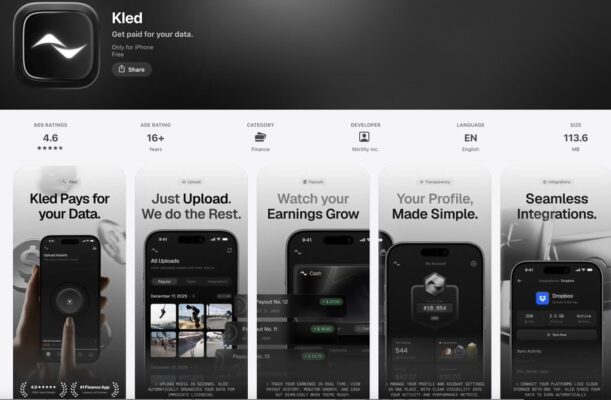
The developer of US-based data platform Kled has announced the removal of its application from the Nigerian app store, alongside an IP restriction affecting the region, citing what it described as an “unmanageable level of fraudulent activity” on the platform.
Kled is a data marketplace that rewards users for uploading photos, videos, and other multimodal content.
The development was disclosed on the X handle of Kled’s founder, Avi Patel, on Monday, May 4, where he stressed that the decision was not targeted at users in Nigeria but driven by security and operational concerns.
“We have removed Kled from the Nigerian app store and IP banned the entire region,” he wrote.
ADVERTISEMENT
Patel, however, clarified that the company holds no negative sentiment toward Nigerian users, noting early adoption and support from the region.
READ ALSO: Workers Day: Tinubu Declares Insecurity, Poverty National Emergencies
“I have nothing against Nigeria. I have a ton of friends from this region and these were some of our earliest app adopters. Genuinely, thank you all for the support,” he said.
According to him, Kled has been operational for about four months since exiting beta, during which users reportedly uploaded over one billion assets and the company paid out “hundreds of thousands of people” for data contributions.
However, he alleged that internal reviews revealed a high volume of manipulated or non-authentic submissions originating from Nigeria.
“After several months of uploads we found that Nigeria had a ≈95% fraud rate. Instead of real, usable data, users were uploading pictures of black screens, duplicate photos, internet generated images, AI generated images, etc. at an unimaginable scale,” he stated.
ADVERTISEMENT
He contrasted this with other markets, including Malaysia, Indonesia, and the Philippines, which he said recorded fraud rates below 10 percent despite significantly larger user bases.
Patel further explained that the situation escalated over the weekend with what he described as a surge of falsified identity documents used in the platform’s verification system.
“This weekend we were flooded with thousands of fake Japanese passports and identity cards with Nigerians photoshopped onto them in our KYC system. That was the final straw,” he wrote.
He added that the decision to suspend access was taken to mitigate financial and operational strain on the startup, while the company works to strengthen its fraud detection systems.
“As a startup we can’t afford to eat the costs of that data overhead, so we temporarily removed the app from the region while we improved our fraud detection and banning system to quickly filter out bad actors when the time is right,” he said.
ADVERTISEMENT
Patel also noted what he described as repeated pressure on the company’s public communication channels, saying responses demanding reinstatement were becoming overwhelming.
“On top of all of this, every time we make a post there is someone asking us to bring the region back within seconds. We hear you, but it’s gotten out of hand,” he added.
Despite the suspension, the company maintained that the move is temporary and not permanent.
“We’ve made this decision with great care. We love everyone who has genuinely supported Kled from Nigeria, and we hope to return when the time is right,” the statement concluded.