
In what appears to be a disturbing and recurring trend now threatens the safety and reputation of Lagos State, the Centre of Excellence. Area boys, popularly known as “omo adugbo” or “omo taku,” have increasingly assumed the role of self-appointed “agents,” demanding unauthorised payments from journalists before granting them access to public spaces and communities to carry out their reporting duties.
In this account, AYOOLUWA AYOBAMI chronicles his fear-filled experience, highlighting how such intimidation poses serious mental health risks and directly undermines the practice of journalism.
The growing presence of so-called “area boys,” popularly referred to as “omo taku,” “omo adugbo,” or “omo ita,” is increasingly affecting the practice of journalism in Lagos.
Reporters now face a disturbing reality: paying “unofficial,” unreceipted fees just to carry out their work. These payments, neither documented nor justified, have become a recurring barrier in the field.
Within the past year alone, I have had three separate encounters of this nature, and honestly, it is no longer amusing. The way these men demand such fees is alarming, but the most recent incident in the Makoko community hit particularly hard.
It was a sunny Tuesday morning when I set out to Makoko to report firsthand on the Lagos State government’s demolition that left hundreds displaced and homeless.
I left the office with my colleague, Victor, and the driver, carrying my journal, pen, camera, and phone, ready to engage residents and amplify their voices to the government.
Upon arriving, our driver sought a safe place to park. Before we could even finish, a light-skinned young man approached the car, shirtless, and asked our purpose.
We introduced ourselves and explained our mission. Deep down, I sensed this was a mistake. Moments later, he had hurriedly worn a West Ham United jersey and appeared slightly more presentable.
READ ALSO: Lagos Assembly Meets Makoko Residents, Orders Stop to Demolitions
As he spoke, five other men joined him, forming what looked like a gang. The first man claimed he would grant us access to the waterfront, but only after we sent him to visit the Baale -the community head, on our behalf, and appeased him with a “schnapps and groundnut.”
“Leave the Baale’s issue alone, we would pay him a visit ourselves,” we said.
“Ok,” they replied, “But you’ll have to rent a boat to travel across the water, and that is N5,000 per boat, and we might need two.”
“Why do we need two boats? We’re only two persons; the driver will wait,” I questioned.
They said two boats were needed because of their gang members, but I declined.
“Okay,” they said, “but you’ll still have to settle us with N100,000 before you can visit the waterfront or interview anybody in this community. We control the policemen too, in case you want to go to the station for help.”
I pleaded, explaining we didn’t have that much. After 30 minutes of back-and-forth, they finally lowered their demand to N50,000.
In my mind, I wondered: What is this money for? Who collects it? Who accounts for it? Ultimately, we were turned away because we refused to pay, escorted out of the community to prevent us from entering through another route.
A colleague later shared a video from the same community, and my heart ached for the children and vulnerable residents who cannot defend themselves. I realised that my voice, which could have contributed to advocating for these people, was stifled by miscreants posing as “area boys.”
Makoko, a sprawling settlement on the Lagos Lagoon, is home to some of Lagos’s most vulnerable residents. Maybe described as Africa’s largest floating slum, the community is built on wooden stilts, with homes and livelihoods intricately linked to fishing.
Life here is marked by limited access to clean water, sanitation, electricity, and waste management, reflecting Lagos’s chronic housing shortages for its population of over 20 million.
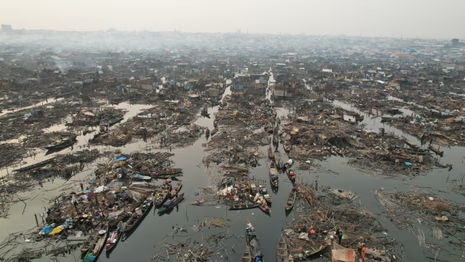
For more than a century, Makoko has housed around 300,000 people. But in recent weeks, homes, and businesses have been destroyed, leaving behind floating debris: corrugated zinc sheets, wooden planks, broken canoes, and scattered fishing nets. Thousands of families are now homeless, stripped of both shelter and income.
The demolitions reportedly came with little notice and no compensation, echoing previous displacements in Lagos.
For a community that has endured for generations, the destruction represents not only the loss of property but a profound blow to its social and economic fabric.
The Lagos State government has consistently described Makoko as an environmental and security hazard, citing fire risks, unplanned structures, and flooding.
Governor Babajide Sanwo-Olu defended the demolitions, saying: “We are not demolishing the whole of Makoko; we are clearing the shanties so they do not get to the Third Mainland Bridge and stay behind the high tension. We are aware that there are some local and international NGOs that want to profit from this.”
For residents, however, the trauma continues. Weeks after the demolitions, families are still grappling with losses that extend beyond property, affecting livelihoods, daily life, and children’s education.
The Lagos State Government on Monday, however said about $10m was being planned for the regeneration of Makoko, a waterfront community in Lagos.
The Special Adviser to the Governor on E-GIS, Dr Olajide Babatunde, made this known while briefing the press at Alausa, Ikeja, on recent incidents involving Makoko.
He said: “So, Mr Governor committed $2m and we are expecting $8m counterpart funding from the United Nations. But I’m sure we all know what is happening today — funds are no longer readily available from most donor agencies.”
While the Lagos State House of Assembly’s intervention has helped ease tensions, displaced residents say relief remains unclear.
In a significant move, the Assembly on Tuesday ordered an immediate halt to the demolition of waterfront structures in Makoko. The directive followed a stakeholders’ meeting between Assembly members and community residents at the Assembly complex.
Beyond clearing shanties off Lagos streets, there is an urgent need to address the menace of miscreants who pose as “area boys,” obstructing meaningful work, including journalism, while exploiting vulnerable communities.